
Insights & Opinions
bunq-as-a-Service: Leveraging Open Banking to Serve more Customers with Joe Wilson, Chief Evangelist
Mon, 13 Jul 2026
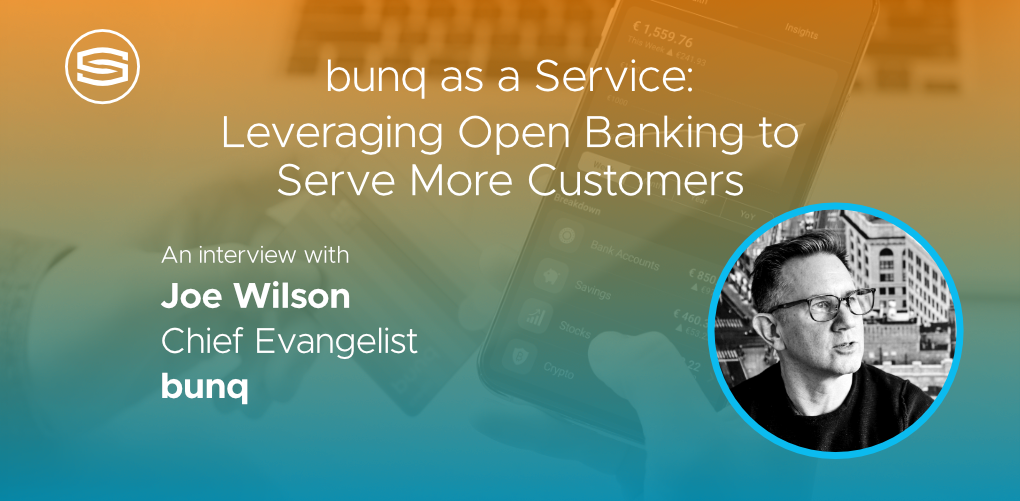
bunq recently announced a new service line: bunq-as-a-Service. Over the past month I met Joe Wilson, Chief Evangelist at this neobank, at our Flagship event in Brussels, and later again by accident at Money 20/20, and so I approached Joe again for a deep dives in bunq-as-a-Service and Banking-as-a-Service in general.
Welcome, Joe. We've been meeting up quite a few times lately, haven't we?
Hi, thanks. We've seen each other more than ever before, indeed (laughs).
Thanks again for taking the time. bunq recently made quite a surprising announcement, in my opinion, definitely one worth talking about. You announced bunq-as-a -Service. As bunq's Chief Evangelist, could you briefly explain to our audience what this is about?
In the simplest of terms, bunq-as-a-Service is about extending our platform to B2B, so Banking-as-a-Service, in a sense, allows other companies that align with the direction and purpose we're on to also extend that.
I think you know us by now, Rik, that we're quite obsessively focused on a particular group of users. Within that group, we are looking to partner with other companies that want to extend that capability as well.
To clarify for those unfamiliar: this mainly concerns frequent travellers who rely on digital services and want reassurance that these services function properly not just in the Netherlands but also in the United States and other countries?
I'll be more precise. We focus on people whose lives extend beyond one country. They're not just travelling but living. So they either live in one country, are from another, have family in another, are on an assignment, or are a digital nomad or digital expat. Yeah. We are nomads.
I guess your family is the best example of that, and that gives you people perhaps also some context about why you're sitting in your bedroom.
Yes, this is the context for why I'm sitting in my bedroom. I moved out of my office because our kids are coming to visit. So, yeah, the idea is that we are a family that has lived in seven different countries on three different continents, and all four of our kids grew up internationally, although they're American, it's not their passport that they identify with.
It's primarily the experiences they had growing up, and quite a lot of that was here in the Netherlands. So the two youngest who are coming to visit actually think of the Netherlands as home. Although American citizens, one considers herself Dutch Canadian and the other considers himself kind of Dutch American, and that's because of the years they spent there.
So bunq has always been a consumer-oriented turn like a consumer-facing bank. Why did you decide to…
Yeah, maybe eighty-twenty because we've always had business accounts, but yes, I think it's our majority has been consumers.
Right, but even offering a business account is a slightly different approach compared to bunq-as-a-Service, where you are more of an infrastructure player rather than a service provider. Does this also represent a strategic direction for the bank, or is it simply another way of scaling what you've already built for the target audience you wish to serve?
Yeah, fair enough. I guess, in that sense, two things can be true at the same time. It is a strategic initiative, meaning we see it as an investment and a priority, something we want to do because we think it's on-brand and on-purpose for us.
And at the same time, it extends our ability to reach our audience and engage our users as we see fit. To keep this in the simplest of terms, this is a place where other companies can use our infrastructure, our KYC, our compliance, our license, and even the €100.000 bank deposit guarantee held with the Dutch Central Bank, and then they can build on top of that. So that's what that bit means.
The Paypers stated in the announcement of this new service: “The expansion takes place against a backdrop of evolving open banking framework across the EU, which has broadened the conditions for third parties to access and build on licensed banking infrastructure”.
I kind of like that, but I'm not sure whether one adds to the other, and that may also be one of the reasons I want to have this conversation, as we're working on a research paper on open banking and embedded finance.
So my question to you is: how important have these open banking regulations and directives been to banks in developing this new service, or could they have done without them as well?
Again, I think two things can be the same in the same way, meaning that I think PSD2 and the upcoming PSD3 are very useful. They say to the world, you know, that banks should be able to extend themselves. And that's sort of a simple statement they make. But to be fair, we didn't do this because of regulation.
This initiative wasn't driven by regulation. We were already building this openly and transparently prior to those types of regulations. So it's not pushed ahead.
So think of it like it's a complement to as opposed to a reason for.
But has the fact that bunq was forced to comply with all these open banking regulations facilitated the development of this new infrastructure? Or would you say that, still, it's as if they didn't really relate?
(thinks) The force to comply was not a reason to do it, no. The idea of extending to more users is the driving force behind our decision to do it. That it is complimentary, I would say, is the best way to say it.
Sure. Today, you already have one key partner; we'll discuss that later. But let’s start with a more open question: what kind of customers are you targeting with this service? I think you hinted towards that already in the very beginning?
Yes, I did hint at it in the sense that these are like-minded companies that are trying to serve a similar audience to the one we're serving, you know. So that's going to be a prerequisite for any of these partnerships. These are partnerships, make no mistake. This isn't something everybody can buy and walk away. These take integration and time, and both parties are quite involved in building it.
No, exactly, the stakes are too high.
Indeed, the costs on both sides are significant. And when we partner with someone, we obviously own compliance, KYC, and related responsibilities. So there's much to consider in the partnership.
The companies we will target, and it doesn't have to be hundreds of thousands of them, we'll be selective, will be those that have a direction towards the user, that have a similar mindset about the priority of the user and the user's needs.
And then ultimately they're extending a service that a particular set of our users would find beneficial. So I would see those as probably the primary criteria.
Maybe the third one can be a little looser from time to time, because, you know, we want there to be a variety in that system and we want to grow this particular side of the business, but I would say we'd like to see all three of those line up.
As I said, you have one anchor partner at the moment: Blockrise. Why specifically them, and how successful is the partnership so far?
We met some time ago with Jos, the CEO of Blockrise, after an initial introduction through the Techleap organisation in the Netherlands. Since then, we've continued to connect repeatedly over time.
The relationship built slowly. And what he really wanted to do was to break down this barrier that exists between the sort of the Bitcoin and the crypto world and the banking world.
You and I both know there are different licenses and different setups. And what he saw with our bunq-as-a-Service was an opportunity to bridge those two worlds in a very smart, clear way.
As a success metric, I can say that currently around 40%of the eligible users have moved to a bunq account. That's a success story given how short an amount of time.
A lot of the crypto world and the digital assets space would like to be considered a normal operating mode of the finance industry. It still has different levels of risk and differences, and the regulations are obviously very different for various reasons.
However, when that money becomes fiat, there's no reason it cannot connect to a bank account and fall under the same guidelines. And we've basically shortened the distance between those two things with Jos, and I think his technology and team do a great job of making that clear and easy for their users.
Crypto is one of the things our users are very interested in, and they want to work with it. We provide that, and Jos’ world gives a sort of extension to that.
Banking as a service has evolved over the past five to ten years. I think it used to be quite a big thing, quite the hype, like the word “AI” is today. Many players were trying to get a piece of the pie. And today, we see a few players actually growing the pie. So the business and the market have grown, but the number of providers has decreased. And so, instinctively, I think there was probably better timing to start this kind of service. Why is bunq trying this now?
Your observation is basically a consolidation statement. And indeed, we had lots and lots of different players, including a few neo banks that came and went, and there's only a number of us that have the staying power and the ability to profit and grow from these markets and conditions.
I think we're doing this now because it's a natural extension for us, at this time. It’s now that we have built the right capacity, size, and capability. There are many things to consider when offering this kind of service. Aside from what has been discussed before, there are also the security components and the compliance components; for example, those are all deeply, deeply serious.
So, to just sort of throw that out there, not having very concrete safety measures in place would be foolish. And we felt that now, we've grown to the point where we can make this offer, and we feel confident sharing it at a level and scale at which it's bulletproof at this point, because I wouldn't want to, you know, put a risk on things. You and I both know we're in this sort of, you know, arms race when it comes to security through AI, and this is a time when we have to offer the best user experience and the best tech. The ones that can do that are going to be the winning combination at some point.
How do you see the market of Banking-as-a-Service evolve in the coming years? Do you expect more consolidation in the space because of the increased expectations or do you think it will evolve in a different way?
I think that none of us knew ten years ago that AI would become what it is. None of us knew. We didn't know that it would be easier to build things. We didn't know that technology would move at the pace it's moving at.
And we also didn't realise that having a banking licence would create something of a moat around a business. You might think of licensing and regulation as a burden, but it's also protection for users and everyone else. So I think this space may see a little bit more consolidation, and I think you're going to have to really decide who you want to bet on.
And I think you have to be able to bet on people whose technology is more advanced, so that you don't take on any risk if you want to partner with them on the back end. And so I expect consolidation to continue, and I also expect Banking-as-a-Service to become more like the partnership model we're putting forward, rather than the pure white-label model we've seen in the past.
I think if I have someone who's banking with 20 million customers, I feel pretty confident about their ability to scale and affect things more so than I do with someone who's just building up a Banking-as-a-Service from scratch.
Some fintechs see bank-as-a-Service as a stepping stone. Once they've reached sufficient scale, they may decide to obtain their own license and bring more capabilities back in-house.
Would you view a successful bunq-as-a-Service customer as someone who eventually outgrows bunq and aims to develop the compliance and security solutions they previously purchased, now bringing those capabilities in-house, or one that remains loyal?
There's that question, the eternal partnership question, in almost any industry, right? Will the partners you sign up today grow large enough to replicate your services tomorrow? And the answer is always the same, which is no, if you do an extraordinarily good job.
Take the example of CRM systems that still exist in the world for sellers and things like that because they're a high speciality use case, and there are other main courses of business that people are in, and they want to use this as a service.
We look at it the same way. We're squarely focused on our users and extending our reach and, you know, capabilities to our users. That's what we really care about the most. So if some of these partnerships end up being able to do that, then great.
If some of them grow and we help them grow, then we’re happy we have improved and grown the ecosystem. So we’re group players. I don't think that's the worst thing that can happen.
I mean, Banking-as-a-Service is something different from, for example, a bakery that starts with third-party products, and later decides to bake its own pies. With banking, you see businesses mature at a certain moment. They outgrow the startup phase to the scale-up phase and into more mature organisations. You see, Revolut was a very good example.
I don't think our partnerships would be the full white-label back end for someone whose core business is banking-as-a-service. I think we have to be an extension of someone else's core business. And that's the way you'd choose your partnership.
So I think that's one level of protection. But again, KYC, AML, time to market, compliance, time to market, all these things, integrating it into MasterCard, Apple Pay, Google Pay, all of these technology levels, plus the security stuff: there are a lot of great partners out there who will see that as the perfect relationship they want for a very, very long time.
Joe, thank you very much for additional information on bunq-as-a-Service.
If you prefer to watch or listen instead of reading the transcript, you can find the full interview on YouTube below or on your favourite podcast channel here.