
Insights & Opinions
What the EPC’s Debate on Agentic Commerce Means for Banks
Mon, 06 Jul 2026

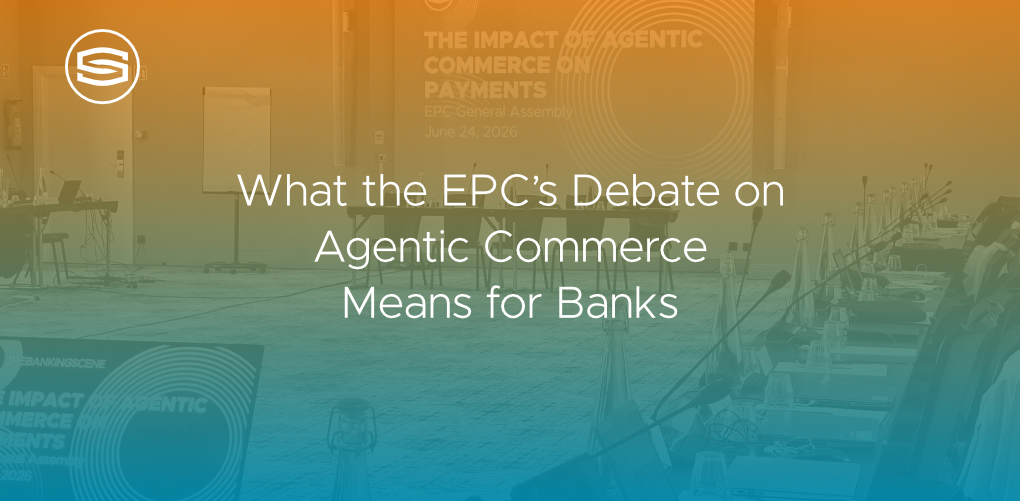
On June 24, 2026, I attended a panel on Agentic Commerce at the European Payments Council (EPC) General Assembly. At first glance, it looked like another discussion about the future of payments. It wasn’t: the discussion turned much more around the commerce aspect, about how merchants and customers find each other in a safe way in the new age of commerce: the one of Agentic Commerce.
“Consumers selected a merchant; consumers chose a product; consumers decided how to pay. Technology helped facilitate those choices. Agentic commerce introduces a fundamentally different model.”
In his introduction, Gijs Boudewijn, Chairman of the European Payments Council, explained why the EPC had chosen to organise this discussion.
“The EPC has always played an important role in creating common frameworks that enable trust, interoperability and innovation across Europe. Agentic commerce is not just a technology discussion. It is also a discussion about trust, resilience, governance and ultimately about how we want the architecture of digital commerce to evolve. Can agentic commerce earn and sustain that trust, while at the same time strengthening the resilience and openness of the payments ecosystem on which we all depend?”
The rest of the conversation was under the Chatham House Rule, so I will share my lessons with you, but not who I learned them from.
The Convergence of Commerce and Payments
For decades, innovation has focused on making the transaction itself faster, cheaper and more secure. Commerce had its own tricks and rules, and both were separate steps in the process. Over time, these steps came closer to each other, and with agentic commerce, we see an entire change in the buying journey.
Instead of consumers searching for products, comparing offers, selecting merchants and deciding how to pay, AI agents will increasingly perform those tasks on our behalf. The payment itself becomes the final step of a decision that has already been made elsewhere.
What I learned from the panel was that nobody around the table questioned whether this shift is coming. The debate was almost entirely about who gets to shape it. Listening to the discussion, I couldn’t help thinking that we’ve seen this movie before.
Have I seen this movie before?
Although I believe this movie is different, Open Banking started with a lot of noise, yet most will agree that the expected market disruptions didn’t materialise. With Agentic commerce, I believe we can expect a happy ending, in the sense that it will come and we must prepare, not because of compliance, but perhaps because of survival.
During PSD2, standards largely came from regulators. This time, they are increasingly emerging from the market itself. Banks are no longer deciding whether to comply with a future standard; they are deciding whether they still have a seat at the table while those standards are being written.
Google is developing the Universal Commerce Protocol. Mastercard is building Agent Pay. The FIDO Alliance is defining authentication frameworks. European initiatives such as EPI are positioning themselves to ensure Europe has its own place in this emerging ecosystem. Everyone agrees that standards matter because whoever defines the standards often ends up defining the market.
Another observation struck me. European payments have spent years building the underlying infrastructure: instant payments, Request to Pay, wallets, Verification of Payee and interoperability. Agentic commerce introduces an entirely new intelligence layer on top of that infrastructure. The intelligence layer is where differentiation moves. Whoever controls that layer increasingly controls commerce itself.
The payment rails themselves do not disappear, but they risk becoming less strategically important than the intelligence deciding which rail is used, under which circumstances and for which merchant.
Being trusted vs being visible
That is a very different competitive landscape from the one banks have traditionally competed in.
Trust was another recurring theme throughout the discussion. Several participants argued that banks remain uniquely positioned because consumers ultimately trust regulated financial institutions with their money. I agree with that observation. Yet I also kept wondering whether trust alone guarantees relevance. Increasingly more people are using the likes of Wise and Revolut purely for their daily banking operations and with Agentic commerce, that shift may accelerate in the reflection to setting up a separate account for those transactions.
But let’s hope that consumers continue trusting their bank while interacting almost exclusively with someone else’s interface. The AI agent becomes the digital relationship manager, while the bank quietly authorises the payment in the background. There is an important difference between being trusted and being visible.
It made me think of another statement by Gijs in his introduction.
At Money 20/202, I heard a speaker beautifully summarise as follows: ‘In the future, customers will make their choices 'in partnership' with their AI Agent.' What is that partnership? Will the partners be equal? What happens to customer relationships when the agent becomes the primary interface? How do banks remain visible when an AI agent chooses the payment method?
It is a beautiful way of describing what lies ahead. But it also raises a number of uncomfortable questions. Are the customer and the AI agent equal partners? Or does the balance gradually shift as the AI becomes better at searching, comparing, negotiating, and recommending than we are ourselves?
And perhaps the biggest question for banks: what happens to the customer relationship when the AI agent becomes the primary interface?
Who should write the next payments chapter in agentic commerce?
The discussion also exposed an interesting contrast between Europe and the rest of the world. Much of today’s experimentation comes from large technology companies and global payment networks, while Europe’s conversation often revolves around governance, interoperability and regulatory alignment. Both perspectives are valuable, but they raise the question: is Europe helping define the future of agentic commerce, or is it primarily ensuring that the future complies with European values after others have already shaped it?
On the other hand, is it bad to lag a bit behind? Europe could prepare the right foundations while allowing early experimentation elsewhere. That is certainly a defensible strategy. But it also raises the question of what point does waiting become following? We have already seen that story play out with cloud computing, mobile wallets and digital platforms.
Agentic commerce is not primarily a payments innovation. It is a distribution innovation. Whoever controls product discovery, customer intent and purchase decisions inevitably gains influence over payments as well. Payments become the consequence of winning the customer interaction, not the other way around.
Banks have tried to keep a grip on the product discovery; their data resources have been stated as a valuable source for understanding customer intent and purchase decisions, but banks have never found the golden solution. My bet is that it is not enough, and players like Google, like the big schemes, are much better equipped for it.
That leaves me with one final question: should banks once again wait until the dominant schemes, protocols and interfaces have emerged before deciding how to participate or should they actively help shape the standards, identity frameworks, and trust models that AI agents will rely on?
If history has taught us anything, it is that by the time standards are settled, many of the most important strategic decisions have already been made. And schemes may not be regulators, but they do set rules, they define mandates, and in this case, they will force their issuers and acquirers to adapt to the new reality, whether that is in their favour or not, whether that is with their wishes or not.
Perhaps this time, banks should not wait for another scheme mandate. Because if they wait until the next scheme mandate arrives, they may discover that the most important decisions have already been taken.
Perhaps they should help write the next chapter themselves.
Download our latest white paper, "AI and The Agentic Future of Banking", for further insights from industry experts on how AI is shaping the future of banking.
The Banking Scene: Director's Cut
Rik and Andrew share their thoughts on what was missing from the debate, as Andrew cut out the final round of questions in order to wrap the session up on time. You can watch or listen below or find us on your favourite podcast platform here.