
Insights & Opinions
Agentic AI in Banking: How European Banks Can Stay Relevant as Customer Agents Take Control
Mon, 22 Jun 2026

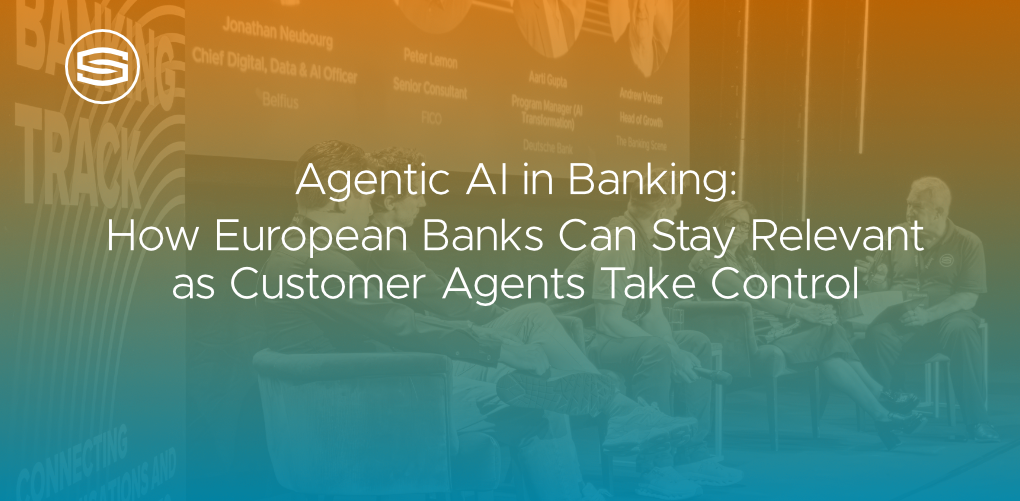
As I was already deep into researching our next white paper on AI and the Agentic Future of Banking (keep an eye out for publication in early July), I quickly volunteered to moderate the panel: “Rethinking Relevance of Customer Engagement in the Age of AI” at our flagship event in Brussels last month with Edwin Sanders, Innovation Lead at Rabobank, Jonathan Neubourg, Chief Digital and AI Officer at Belfius, Aarti Gupta, Programme Manager (AI Transformation) at Deutsche Bank and Peter Lemon, Senior Consultant at FICO.
At the start of the session, the room was full of people who I’m sure had heard the disruption warnings of the waves that came before: digital transformation was going to be the end of physical branches, the fintechs were going to disintermediate the banks, and Open Banking was supposed to hand the customer relationship to aggregators. None of which quite played out as predicted (although we do have significantly fewer physical branches these days). So when the conversation turns to agentic AI and similar warnings, I can understand a healthy degree of scepticism.
By the end of the session, most (I hope) of that scepticism had been replaced by a more urgent question: not whether agentic AI will reshape banking, but whether banks will be the ones shaping it.
Another Channel Is Arriving, Whether Banks Are Ready or Not
Edwin Sanders offered a deliberately unhurried framing of the shift. “When I was born, we had a lot of branches,” he said. “Then, when I got a little bit older, we also got a digital channel. I think the next trend will be that a lot of people will be using the agentic channel.” The analogy he reached for was the iPhone: just as a single device absorbed the camera, the calculator and the map, agentic AI will absorb many of the software functions that today live separately across a customer’s digital life.
The practical implication for banks is not that the other channels will disappear. Edwin’s point was subtler: each channel demands a different definition of relevance. In a branch, relevance is human and social. In a digital app, the focus is on self-service and control. In the agentic channel, relevance must become predictive. He illustrated this with a simple example: if a customer attempts their weekly grocery shop with an insufficient balance, the agentic world will not wait for them to notice the failed transaction and log in to top up their account. A genuinely relevant agentic system would have anticipated the shortfall and acted before the moment of failure.
The Commoditisation Threat Is Real, and Closer Than Most Banks Assume
Peter Lemon brought the external industry perspective and did not soften it. FICO has published research warning that autonomous customer agents, capable of comparing products, negotiating terms and executing transactions without human intervention, could commoditise banks by reducing competition to price and execution alone. Asked how imminent that threat was, Peter placed it firmly within the current planning horizon by saying: “It took the telephone fifty years to reach 100 million users. OpenAI did that in two months. We are at a point in history where adoption of AI is at a rate that we have never seen anything like within human history.”
The demand, he argued, has been latent for years. Research from 2022 showed that around 60 per cent of consumers wanted their banks to make it easier to find and shop for financial products. Four years later, that need remains largely unmet by the banks themselves, but platforms such as the German savings-rate aggregator Raisin have already demonstrated that customers will adopt friction-reducing services readily. Agentic AI simply removes the last remaining layer of friction.
Most strikingly, FICO World research presented the previous week suggested that approximately one in three consumers would already be comfortable with AI making the final buying decision on their behalf and amongst younger demographics, the majority would prefer that agent to sit outside their bank entirely!
Where Agentic AI Is Already Delivering Measurable Value
Aarti Gupta brought the discussion back to the concrete realities of corporate banking operations. Her argument was that the near-term value of agentic AI lies precisely where the work is most manual, most document-heavy and most rules-bound: back-office operations, compliance monitoring and credit processing. Citing McKinsey research from 2025, she noted that organisations deploying agents in operational workflows had already reported productivity gains of between 20 and 50 per cent, with one unnamed US bank achieving between 20 and 60 per cent productivity improvement in its credit memo process alongside a 30 per cent reduction in turnaround time.
Deutsche Bank’s own February 2026 announcement of a partnership with Google, applying AI to the monitoring of trading communications and the identification of compliance anomalies, illustrated the point: the heavy lifting is increasingly being done by machines, but human oversight remains in place for decisions that carry legal and reputational weight.
Aarti was equally direct by saying: “Deploy where you see the monotony, the frequency and the repetition, and where errors can be turned around and reviewed manually,” she advised, following with a caution of: “Be careful where errors cannot be turned around and can lead to higher impact, especially when it comes to reputational damage.”
Why Agentic AI Programmes Stall Before They Reach Scale
Peter returned to one of the more uncomfortable findings in FICO’s research: 95 per cent of organisations report a lack of alignment between their AI initiatives and their business goals. In his experience advising financial institutions across EMEA, five patterns recur.
- First, governance frameworks for AI models, covering bias detection, model drift, ownership and board-level oversight, are only now being established in many banks.
- Second, large language models, for all their power, are generalists; financial services require the precision and contextual accuracy of domain-specific models.
- Third, even when a proof of concept succeeds, the route to production within everyday business-as-usual processes is often poorly architected.
- Fourth, there is a failure of ambition: using AI to automate existing processes rather than to enhance and improve them.
- Fifth, siloed AI initiatives across different parts of a bank generate inconsistent standards, incompatible infrastructure and fragmented returns on investment.
Accountability in an Autonomous World: A Question Without a Simple Answer
If the productivity case for agentic AI was broadly accepted around the panel, the governance question proved a bit more contentious. I asked: “When an autonomous agent takes an action that causes harm, who is responsible?” Aarti proposed what she called a layered accountability model, in which the business provides strategic direction and guardrails, the technology team owns model accuracy, and the user who provides the input shares in the outcome. Accountability, in this framing, belongs to the layer at which the failure occurred, not to a single nominated owner.
Jonathan illustrated what makes this question so difficult in practice. He described an internal discussion about an AI solution for car leasing that could potentially be delivered with 99.5 per cent accuracy. A colleague raised concerns about the 0.5 per cent error rate and asked what should happen if the customer gets a car with an option they didn’t order or perhaps didn’t get one they specifically wanted. This sparked an interesting discussion about how humans would handle those kinds of errors today. The standards applied to AI errors and human errors are not equivalent, and bridging that gap requires both cultural change within organisations and a broader societal conversation about the distribution of responsibility between institutions, technology providers and customers.
Jonathan was equally emphatic that auditability is the foundational requirement: the ability to trace exactly which choices were made, where they were made, and at which point in an agentic workflow something went wrong. Without that, neither regulators nor customers will extend the trust that agentic banking ultimately requires.
Trust, Fraud and the Loyalty Question
I closed the session by posing the same question to each panelist: “In five years time, will customers be more loyal to their bank or more loyal to their AI agent?”
Peter noted that banking loyalty has been declining for decades and that 70 per cent of people already hold accounts with more than one financial services provider.
Aarti predicted a shift towards agents, suggesting that the future role of the bank is not to be the best, but to become irreplaceable.
Edwin offered the most memorable reframe, observing that measuring app logins as a proxy for relevance is just wrong: “I go five times a day to my front door. Do I have a fantastic front door, or is it just the only place I can leave my house?” The goal, he argued, is relevance measured by genuine value, not by frequency of interaction.
Jonathan took the contrary position. Trust, he argued, will matter more in an agentic world than it does today, not less, precisely because the threats will also scale. Fraud and impersonation are already evolving at pace; agentic technology is available to those with harmful intentions just as readily as it is to those building customer value. “People are developing agents that claim to be X but they represent Y,” he warned. In a world where the agent layer is populated by both legitimate and fraudulent actors, the value of a trusted brand as an anchor of verification becomes, if anything, greater.
In my opinion, the race will not be won by appealing to customer agents, but by appealing to the customers who wield them. Banks that earn the loyalty of the person rather than the algorithm will find, as they have through each previous wave of disruption, that relevance is not a feature to be built. It is a relationship to be maintained.
This interview is included as a reference source for our white paper: "AI and The Agentic Future of Banking", that features exclusive interviews with senior banking executives, technology leaders and AI experts, together with insights gathered through The Banking Scene's research, think tanks, industry events and third-party papers, which you can download on the link below.