
Insights & Opinions
Beyond the App: Why Benelux Banks Must Stop Chasing Today's Benchmark
Mon, 20 Jul 2026

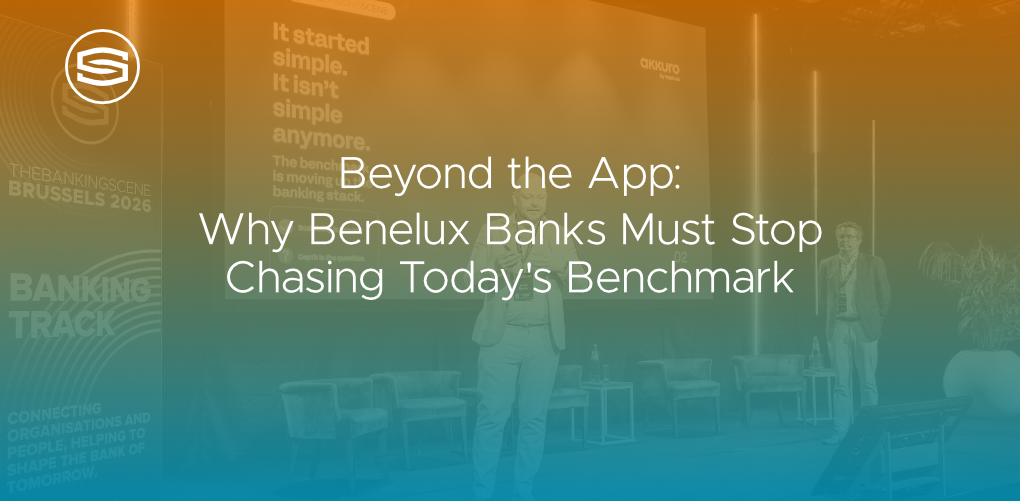
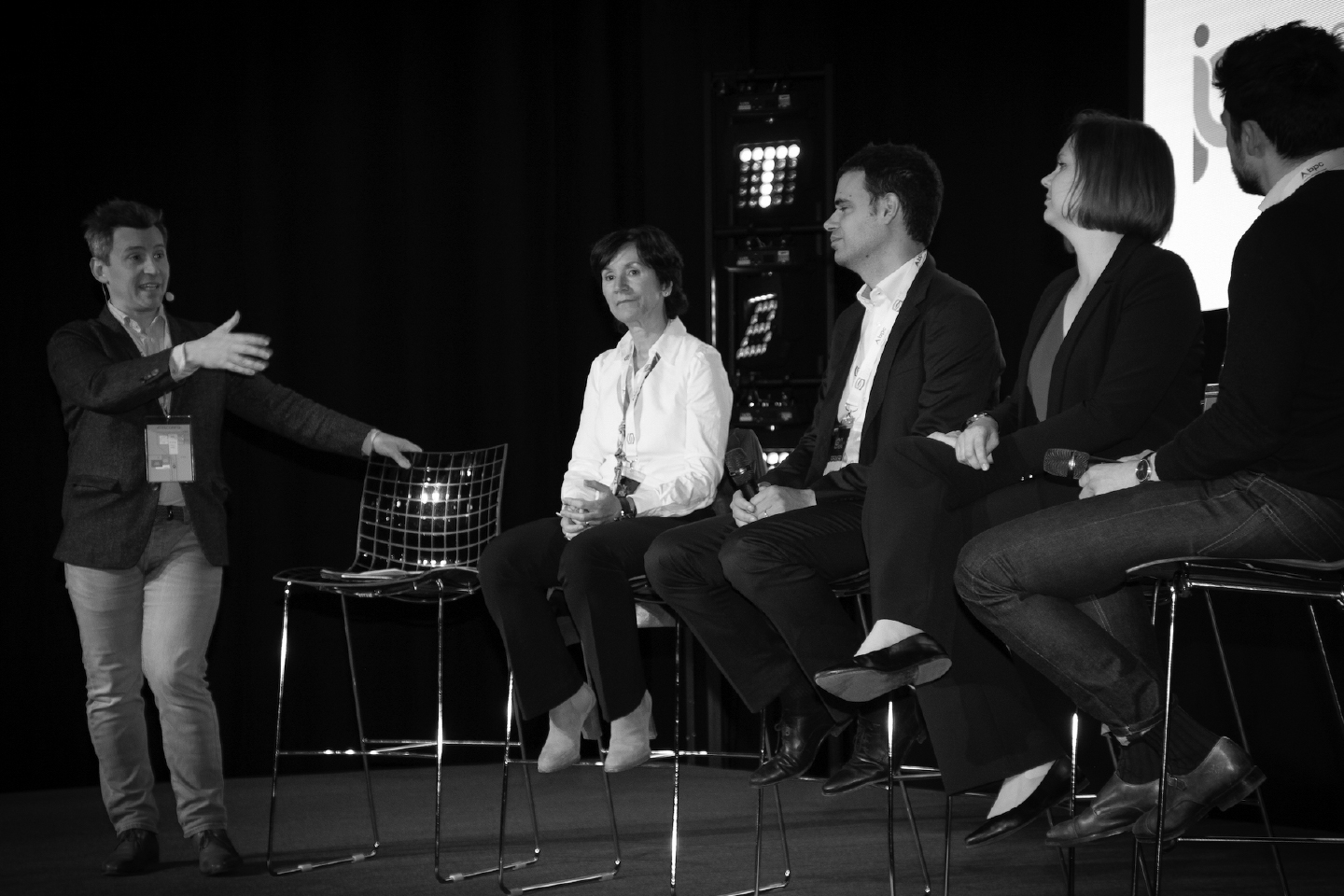
At our flagship conference in Brussels in May this year, Frank Schooneveldt, Managing Director of Savings and Investments, and Jamie Burink, Chief Growth Officer, from Akkuro by Topicus, delivered a keynote with an uncomfortable message for established banks: “the model you are trying to catch up with is already out of date”.
Their argument is not that banks should imitate the latest fintech challenger more quickly; it is that imitation itself is the wrong strategy. By the time a bank has replicated today's benchmark, the benchmark will have moved on again.
For banking professionals across the Benelux region, where legacy infrastructure and product silos remain the norm, this is a timely provocation.
The New Benchmark: Rethinking What "Scale" Really Means
Jamie opened by putting two numbers side by side. One challenger bank, which only recently obtained a full banking licence, reached 70 million customers in under a decade with roughly 12,000 employees. By contrast, Europe's largest incumbent bank serves 41 million customers with 211,000 employees. Jamie was quick to address the obvious objection: this is not a fair like-for-like comparison, and that was never the point. The point is the speed and efficiency with which that scale was achieved, and the fact that established banks are visibly racing to close the gap.
Crucially, the challenger in question (I think we all know who it is …..) is no longer confined to simple products. It has moved into mortgages and lending, and many rival neo-banks are also pushing into investment products backed by major asset managers, alongside exchange-traded funds and wealth management.
The complexity ceiling that once protected incumbent banks is disappearing.
The Real Ingredients Behind the Benchmark
According to Jamie, the temptation is to explain this success purely through slick apps and strong customer affection. Both matter, but they are not the whole story. He pointed to three structural ingredients instead:
- a single global brand and identity,
- one common app used everywhere the bank operates (adapted for local regulation but architecturally identical), and
- a single orchestration layer underpinning the entire operation.
In other words, the achievement was not simply user experience polish. It was a technology operating model built to scale on one platform from day one.
This distinction matters for Benelux banks. Many have invested heavily in improving digital experience, yet still run fragmented product silos, duplicated data models, and channel-specific logic behind the interface. This theme has also repeatedly surfaced across multiple round table Think Tank sessions we have run over the last year.
The keynote's message was that cosmetic modernisation without architectural change will not close the gap.
Why Chasing the Current Benchmark Is Already Too Late
Jamie introduced what he called the "law of accelerating lag": the moment a bank commits internally to replicating today's leading model, that model is already evolving into something else. His estimate was stark. A large, established bank beginning that transformation today might be only halfway there in five years, by which point the benchmark it set out to match will have shifted again.
His challenge to the room was to think in terms of order-of-magnitude ambition rather than incremental catch-up. He posed three provocations worth contemplating:
- If a fully digital challenger bank needs no branches, why does it still employ thousands of people?
- What becomes possible if the underlying technology genuinely understands context, including a customer's full portfolio and the regulatory environment a bank operates in?
- What if a bank's own institutional knowledge, currently held in the heads of experienced staff, could be productised and executed autonomously, at scale, rather than trialled only in limited pilots?
These questions frame the shift from copying a competitor's features to rethinking what a bank's operating model is for.
Agentic Banking: The Architecture Behind the Buzzword
This is where Frank introduced Akkuro's architectural view of agentic banking. He was careful to stress that this is not artificial intelligence bolted onto legacy infrastructure, nor a chatbot layered over existing systems. The model he described has four layers:
- Core banking layer – the existing platforms for payments, lending, wealth and cards.
- Control layer – permissions, policies, risk guidelines and compliance rules already in place.
- Context layer – the new element Akkuro considers essential, combining data, knowledge graphs and large language models with existing APIs and services to give agents the situational understanding they need to act appropriately.
- Orchestration and experience layer – coordinating agent activity and delivering it through the interfaces that customers and employees actually use.
The context layer is presented as the genuinely new component. Without it, Frank argued, artificial intelligence in banking remains superficial: capable of answering questions but not of taking informed, compliant action on a customer's behalf.
From Idle Cash to Confident Financial Action
The keynote grounded this architecture in concrete wealth management use cases already in development or deployment at Akkuro.
The first addresses idle cash: an estimated €10 trillion sits in European savings and term deposit accounts, effectively passive capital that could be productively allocated into investment products, held back largely by trust, risk perception and financial literacy. Akkuro's proposed response includes agents that surface peer-group context to customers and offer contextual coaching, blending personal financial goals, peer behaviour, risk appetite and market volatility to guide (not replace) a customer's investment decisions.
The second use case is described as outcome-driven financial orchestration: agents that monitor life events such as a child starting university, a planned major trip, or approaching retirement, and proactively surface relevant nudges, planning support or portfolio adjustments. Frank was explicit that the ambition extends across domains. Customers do not experience their finances as separate silos for cash and wealth, so the technology supporting them should not either.
Start Small: A Practical Path, Not a Big Bang
Given the scale of this vision, an obvious concern for any bank is implementation risk. Frank addressed this directly: the answer is not a wholesale rebuild of the bank in one move. Instead, he recommended identifying a single, well-defined decision or action, productising the knowledge behind it, and exposing it safely with proper guardrails, compliance controls and human oversight built in from the outset. Only once that first step is proven should banks extend the model further.
This incremental approach is likely to resonate with Benelux banking professionals operating under close regulatory scrutiny from national supervisors and the European Central Bank. It offers a way to explore agentic capability without exposing the institution to unacceptable operational or compliance risk.
What This Means for Benelux Banking Leaders
The core message from Akkuro's session is a reframing of competitive strategy. Establishing feature parity with the fintech challengers that have redefined customer expectations is not, by itself, a viable long-term goal, since that target keeps moving.
The more robust opportunity lies in building the operating model of the next benchmark: one where context, permissions, workflows and regulatory discipline are embedded from the ground up, rather than added afterwards.
For banks across the Netherlands, Belgium and Luxembourg, many of which are already investing in composable banking infrastructure, this keynote offered a useful lens for evaluating those investments.
The question is not whether the current digital-banking model matters. It clearly does. The more useful question, as Akkuro framed it, is what an established bank intends to build next, and how soon it starts.
Download our latest white paper, "AI and The Agentic Future of Banking", for further insights from industry experts on how AI is shaping the future of banking.