
Insights & Opinions
Generative AI for Finance Leaders: Why the Hardest Part Is Not the Technology
Mon, 05 Oct 2026

Generative AI has sparked a flood of bold predictions about the future of financial services. Autonomous finance functions, AI agents making decisions on our behalf, dramatic productivity gains and even the disappearance of entire categories of jobs have all featured prominently in the debate.
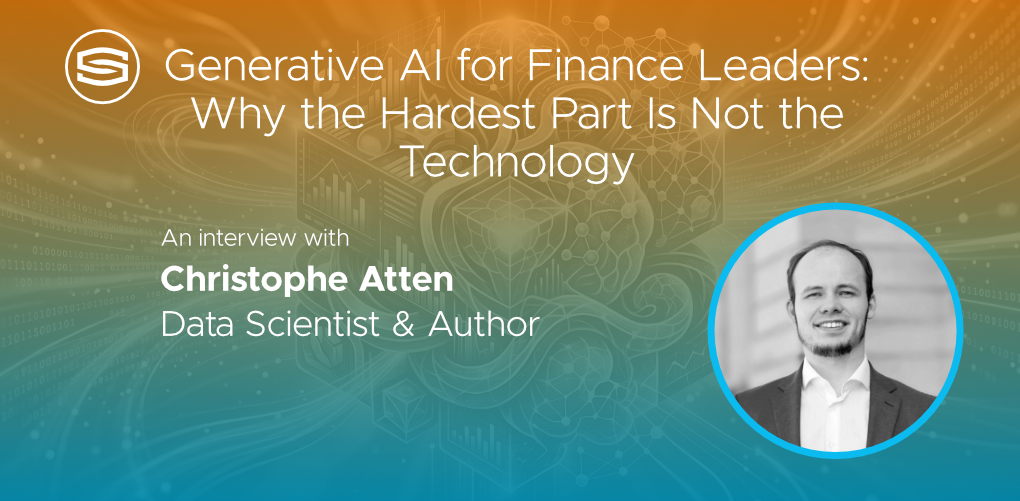
Drawing on over a decade of working in data science and AI in financial services, Christophe Atten (a familiar face to many people who have attended our events in the past) has written “Generative AI for Finance Leaders: A Practical Guide to Strategy, Governance, Adoption and Real Results”, and I had the pleasure of <virtually> sitting down with him to find out more.
Rather than trying to predict when artificial general intelligence will arrive or what finance functions might look like in 2035, he focuses on what matters now:
- What can finance leaders actually do with generative AI today?
- Where does it make sense and where does it not?
- Who remains accountable when something goes wrong?
- And perhaps most importantly, how do organisations move from impressive demonstrations to AI that creates sustainable value?
These are questions Christophe says repeatedly surfaced while teaching finance professionals how to use AI. Eventually, he decided it would be easier to write the answers down than to repeat them endlessly. The result is a book that cuts through much of the excitement surrounding AI: the technology matters, but successfully adopting it may have far more to do with people, processes, data and judgement.
Moving the generative AI conversation beyond the hype
One conscious choice he made when writing the book was what to leave out.
There are no grand predictions about artificial general intelligence, mass job displacement or fully autonomous finance functions. As he explained during our conversation, those subjects might perform well on LinkedIn or YouTube precisely because they are controversial. But they are less helpful to somebody arriving at work on Monday morning wondering what they should actually do.
Instead, he has concentrated on capabilities, use cases, accountability, governance and change management. That is also why the book avoids building its arguments around individual products, screenshots, and current pricing, since those could be obsolete almost as soon as the book is published.
The underlying frameworks should have a longer shelf life.
That distinction matters because the conversation around AI can easily get dominated by what the latest model can do, yet the more useful question for an executive is, "What should we use it for?"
Why AI adoption is really a people challenge
For somebody with Christophe’s data science background, his answer to the question of what makes AI difficult might initially seem surprising:
“It is not the technology; it is the humans”.
Installing a new tool can often be done in an afternoon, while changing how people work takes much longer. Some employees may worry that AI threatens their role. Others may fear that asking an AI for help makes them appear less competent. Some may simply distrust the technology. A training session is unlikely to resolve those concerns overnight.
"Humans are very adaptable," Christophe argues, but they need to understand why change is happening and see the value it creates. Turning a technical capability into a dependable part of everyday work therefore requires leadership, patience and change management.
This has implications far beyond the finance function. Although Christophe wrote the book specifically for finance leaders, many of its frameworks around governance, readiness, use-case selection and change could equally apply elsewhere in a bank or other industries.
Use cases may differ, and regulatory considerations may change, but the organisational challenge remains remarkably familiar.
Not every banking problem needs generative AI
Perhaps one of the healthiest principles in Christophe's approach is also one of the simplest, and one that we repeatedly hear across our stages and events: just because you can use AI does not mean that you should.
There is considerable pressure on organisations to demonstrate that they are “doing something with AI”. But adding generative AI to a process just to tick that box can make it more complicated, less predictable, and potentially more expensive.
Christophe gave a straightforward example: Generative AI might be useful for interpreting an unusual explanation contained within an email accompanying an invoice, but checking whether the invoice number already exists is a database task, and there is little benefit in asking a probabilistic system to do something that conventional software can do deterministically.
This becomes significantly more important when decisions carry financial, regulatory or customer consequences. Would Christophe allow generative AI to decide whether a banking customer should be classified as high risk? No. He would rather have experts establish clear rules that can be consistently applied and subsequently evidenced.
His argument is not anti-AI; it is about matching the right technology to the right task.
That distinction could become increasingly important as banks move from generative AI towards agentic AI.
Agentic AI needs boundaries, not autonomy for its own sake
Agentic AI is rapidly becoming one of the industry's favourite terms. Yet greater autonomy is not automatically synonymous with greater value.
An agent retrieving approved documents or handling defined exception files operates within relatively clear boundaries. Allowing the same system to change suppliers or initiate payments creates a very different risk profile. For Christophe, the more practical near-term model for finance may therefore be a controlled workflow combining deterministic automation with generative AI, rather than an autonomous collection of agents deciding independently what should happen next.
This challenges an assumption sometimes embedded in discussions about agentic AI: that removing humans from a process is itself the objective.
It should not be.
The objective is creating value.
If additional autonomy introduces more governance, assurance and implementation costs than the value it creates, it is difficult to justify.
Sometimes 30 per cent less manual effort is a better outcome than pursuing 100 per cent automation.
Why fluent AI answers could be dangerous in banking
If there is one idea Christophe hopes readers remember six months after finishing his book, it is this:
“Fluency is not evidence of accuracy”.
Generative AI is remarkably good at producing answers that sound convincing. The problem is that the confidence and polish of the answer do not necessarily tell us whether the underlying information is correct (which I pointed out holds true of many people I have met too!).
For financial institutions, where numbers, evidence and accountability matter, that creates an obvious challenge.
Christophe therefore sees human oversight remaining central, but importantly, he does not believe the human should simply appear at the end of an automated process to approve the final result. Instead, human validation should be inserted at appropriate points throughout a workflow, allowing an expert to check evidence before the system proceeds to the next stage. AI can find information, extract it and present it for review. The human verifies that the evidence supports the conclusion.
That sounds reassuring, but it introduces another problem: what happens when the AI is right 99 times out of 100?
To me, there is an obvious danger that oversight eventually becomes little more than rubber-stamping and I expressed my concerns.
Christophe acknowledged the risk, although he pointed out that it already exists in human processes! Senior employees routinely develop trust in experienced colleagues and may consequently scrutinise their work less closely. The answer, therefore, is not simply to demand "human-in-the-loop" oversight. Organisations need to understand how their AI systems fail and design controls around the significance and nature of those potential failures.
Will AI make expertise more valuable, not less?
This led to one of the most interesting paradoxes raised during our conversation.
If humans are expected to validate AI-generated work, they need sufficient expertise to recognise when it is wrong.
But as AI increasingly takes responsibility for drafting, researching, extracting and analysing, the human role shifts towards reviewing, challenging and interpreting.
Christophe believes that can actually require more expertise.
A non-expert presented with a plausible explanation for declining revenue might accept it. An experienced professional may notice another number that contradicts the conclusion and challenge the AI accordingly.
So where will tomorrow's experts come from if today's junior employees increasingly delegate their work to AI?
Christophe is more optimistic about this than some. He compares generative AI with earlier technologies that changed how people acquire information and develop skills. Developers no longer necessarily work in the same way previous generations did, but that does not automatically make them less capable.
The critical issue is how AI is incorporated into learning.
He suggested that rather than just getting AI to do the work and accepting its output, organisations could also use it to generate exercises that help inexperienced employees explore alternative approaches, challenge conclusions, and learn how expert work is undertaken.
That suggests AI literacy may ultimately be less about learning how to write clever prompts and more about learning how to question machine-generated answers.
Generative AI will amplify bad processes
Another uncomfortable reality for organisations hoping AI will solve long-standing operational problems is that it may simply expose them faster.
Christophe describes AI as an amplifier: good data can produce better outcomes, while poor data can produce poor outcomes with impressive speed and presentation.
His more colourful version is familiar to anyone who has worked with technology: "bullsh*t in, bullsh*t out."
For banks and finance functions with years of accumulated spreadsheets, fragmented processes, inconsistent documentation and data-quality issues, this matters enormously as AI does not magically repair those foundations.
But he is equally clear that imperfect foundations should not become an excuse to do nothing!
Banks can begin with bounded use cases where the data is sufficiently understood, and the consequences are manageable. Internal knowledge tools, document extraction and other targeted applications can deliver value while organisations progressively improve their underlying data and processes.
What they should avoid is attempting to automate an entire complex process from end to end before understanding where they are starting from.
The real AI divide will be organisational
This provides the most important clue about where generative AI could take banking next.
Three years from now, the meaningful divide may not be between organisations that "have AI" and those that do not. Access to increasingly capable AI tools is likely to become commonplace.
The more interesting distinction could be between organisations that use AI to rethink how work happens and those that simply bolt it onto existing processes. For example: if a team produces a report faster with AI but retains every old handover, duplicated control and approval layer, it may simply create more material for managers to consume. Local productivity gains do not necessarily translate into organisational productivity.
By contrast, banks that examine the complete process, decide which activities to automate, determine where generative AI adds value, and deliberately preserve human judgement where it matters could achieve much more sustainable gains.
That perhaps explains why the most impressive AI product demonstration is rarely the most important part of the story (sorry, you’ll have to watch or listen to the full interview below for the backstory on this statement 👇).
The capabilities of tools such as ChatGPT and Claude can make enterprise adoption look deceptively simple. What demonstrations do not show is everything required around it: verification, development, controls, governance, risk management, data and organisational change.
Christophe believes most finance leaders risk underestimating just how much work remains between an impressive AI experience and dependable AI inside a regulated financial institution.
That should not discourage you from starting.
Quite the opposite.
It suggests that the organisations most likely to create lasting value from generative AI will not necessarily be those racing fastest towards autonomy; they are more likely to be those asking where AI belongs, where it does not, what humans need to remain responsible for, and whether the processes themselves still make sense.
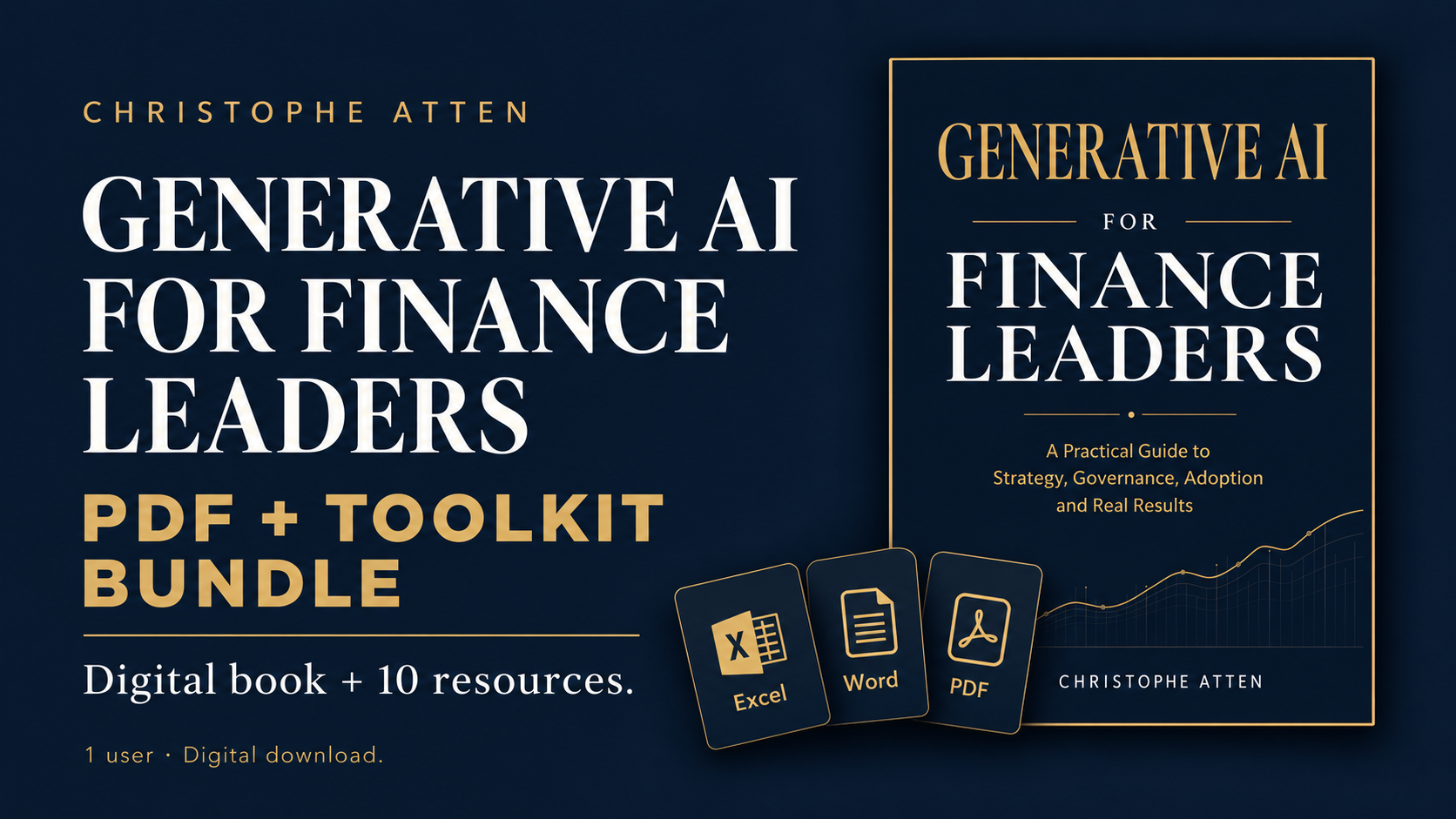
All of which you can get started with today by exploring the book and the toolkit on Christophe's website here.
The Banking Scene: Director's Cut
Christophe shares so many more insights in his interview than I've managed to capture in the article above, so have a watch or listen to the full interview below to hear from him directly and as always, you can find the interview on your favourite podcast platform here.
 Click to explore more