
Insights & Opinions
Regulation vs Innovation: What's Truly Shaping the Future of Payments?
Mon, 21 Sep 2026

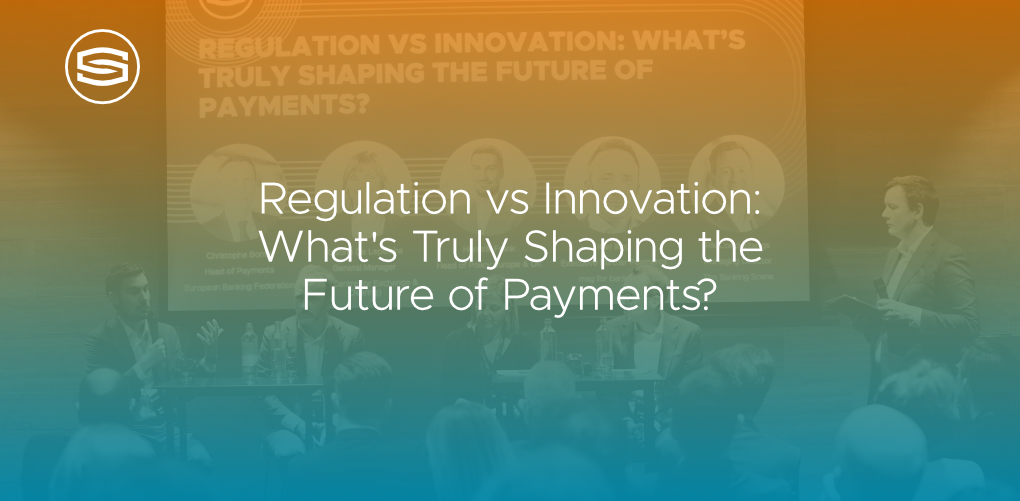
At The Banking Scene BBQ Night 2026, the question hanging over the evening's discussions was a deceptively simple one: is regulation still steering the future of European payments, or has technology already taken the wheel?
Across presentations, a lively panel debate and a closing provocation from one of the industry’s best-known commentators, the answer that emerged was neither straightforward nor comforting. Regulation and innovation are not opposing forces so much as two hands on the same steering wheel, occasionally fighting for control, but ultimately needed together if European payments are to remain safe, competitive and sovereign.
Setting the scene: a payments landscape pulled in two directions
Giorgio Andreoli, Director General of the European Payments Council, opened proceedings by reminding us just how far account-to-account payment rails have come. The Single Euro Payments Area now reaches well beyond the borders of the European Union itself, taking in a wide circle of non-EU states and giving Europe, in his view, a genuinely strong and sovereign payments infrastructure. Yet Giorgio was equally candid about the mounting complexity facing the sector. Successive layers of regulation, from the second and third Payment Services Directives through to Verification of Payee, the Payment Services Regulation and the forthcoming EU digital identity wallet, have each added new obligations on top of the last, often originating from different parts of the European Commission with limited coordination between them.
For Giorgio, the way through this complexity is not to pick a side between regulation and the market, but to accept that every component matters. As he put it, "cross industry coordination is fundamental to this landscape."
A bank's view: six forces, one accelerating pace
That theme of complexity was picked up immediately by Benoit Speybrouck, Director of Operations at Belfius, who set out six forces he sees shaping the future of payments: margin pressure, regulatory evolution, the entry of new providers and neobanks, rising customer expectations, geopolitical and sovereignty concerns, and financial crime.
As Benoit said, none of these forces is new, but their pace and intensity are increasing sharply.
Fraud in particular has become what he called a genuine trust crisis, with Belgian fraud figures reportedly doubling between 2024 and 2025, prompting Belfius to launch more than a dozen initiatives in 2026 alone, from lower payment limits to stronger detection capabilities. Rather than treating this as a burden, Benoit said Belfius chose to evolve its payment platforms gradually rather than pursue disruptive overhauls, partnering with organisations such as SurePay, Isabel and Belgian scale-up Aikido, and taking a stake in the European AI venture Mistral.
Despite the scale of change facing the sector, his outlook was resolutely positive: "we look at it with optimism."
Can regulation and innovation coexist without trade-offs?
The heart of the evening's debate came during the panel discussion.
Christophe Bonte, Head of Payments at the European Banking Federation, argued that European regulation has genuinely driven the payments landscape forward, and pushed back firmly on any suggestion that banks are simply hostile to it. In his words, "regulation is essential, of course, to provide legal certainty for doing business." His concern lay less with the intent of regulation than with its cumulative effect: increasingly detailed, prescriptive rules that create inconsistency rather than a genuine level playing field. The instant payments regulation, he suggested, illustrated both sides of this coin, forcing banks to act after a decade of inertia while simultaneously generating hundreds of pages of clarifying questions and answers.
Kristine De Lepeleire, General Manager of the Centre for Exchange and Clearing, offered a more measured framing, describing the relationship between the two forces plainly: "it's not a trade-off. We need both." Her caution centred on regulators reaching too far into the operational details of banks, citing friction created by bulk file processing under instant payments rules and by the practicalities of Verification of Payee. She also raised a pointed question about fairness, noting that private clearing organisations such as her own compete with central bank infrastructure that is not subject to the same commercial constraints, and stressed the continued importance of resilient domestic payment systems, with more than 89% of their payments being local or domestic.
Hendrik Frank, Head of Policy for Europe and the UK at Adyen, brought the perspective of a pan-European payments provider operating across nearly every EU member state (and beyond). Despite the promise of a single European licence, he described a landscape still fragmented at national borders, where identical rules are interpreted differently from one country to the next, forcing constant re-engineering of otherwise identical services. His conclusion was unambiguous: "we probably need more EU regulation." On fraud specifically, Hendrik argued that the industry remains dangerously siloed in how it shares data across issuers, acquirers, schemes and other digital platforms, warning that "if we cannot see the full story, we're blind."
Karl Illing, Executive Partner for Payments at msg for banking ag, took a more optimistic long view of open banking under PSD2. While the anticipated explosion of application programming interface activity never fully materialised, Karl pointed to genuine, if often invisible, value created in business-to-business use cases, from liquidity checks to loyalty-driven spending insights. When Rik asked him to choose between regulation and innovation as the dominant force shaping payments, he picked regulation for today and innovation for tomorrow, while cautioning that rulemaking will always struggle to keep pace with technology. As he summarised it, "in the long run, regulation won't be able to keep up."
Fraud: a shared, cross-sector responsibility
Fraud emerged as one of the evening's most urgent and unifying themes. Both Hendrik and Christophe were clear that the problem can no longer be treated as a payments issue alone. Christophe argued that fraud typically originates outside the banking and payments ecosystem entirely, often on social media platforms or through phishing, and that regulation must therefore target the platforms where fraud begins rather than placing sole accountability on banks. The consensus across the panel was that better outcomes depend on greater data sharing between banks, payment schemes and digital platforms, supported by a genuinely cross-sector regulatory response rather than payments-specific rules alone.
Trust, technical debt and the lessons of a cashless failure
The evening closed with a keynote from our good friend, Chris Skinner, CEO, author and advisor at The Finanser, who broadened the conversation from regulatory mechanics to something more fundamental: trust.
He set the scene with a rousing song of his own, and aptly in today’s era, AI-assisted, creation that brought the main character of one of his latest fiction (or “Pulp Finction” as he has named his unique genre) books to life before our eyes.
Drawing on decades spent observing, commenting on and advising in the industry, Chris argued that the real vulnerability in financial services has rarely been technology itself. As he put it, "it's not the technology; it's social engineering, people." He illustrated the point with the story of a reformed hacker who bypassed a major bank's data centre security simply by posing as a Friday lunchtime pizza delivery, a reminder that human trust, not cryptography, is often the weakest link.
Chris went on to warn of a different kind of fragility: concentration risk. With much of Europe's and America's payment infrastructure now running on a handful of cloud providers, and artificial intelligence adding further complexity on top, he questioned what would happen if one of those providers failed. He recounted his own experience of a British retailer suddenly unable to accept cards, an anecdote that inspired his recent book and a cautionary tale for an industry that has, in his view, become dangerously dependent on assumptions that payment systems will simply always work.
For established banks, he argued, the deeper obstacle is technical debt inherited from decades-old core systems, a burden that makes it far harder to embrace developments such as stablecoins than it is for newer, cloud-native competitors. His closing message returned to a single idea that ran through the whole evening in different guises: identity, authenticity and trust remain the foundation on which every innovation in payments ultimately depends.
A Benelux perspective on the road ahead
Taken together, the evening's contributions resist a simple verdict on regulation versus innovation. What they suggest instead is a payments landscape shaped by both forces working, and occasionally straining, together.
Regulation has undeniably catalysed genuine progress, from instant payments to Verification of Payee, yet its growing complexity and inconsistent implementation across member states risk becoming a drag on the very innovation it was designed to enable. Technology, meanwhile, continues to move at a pace that regulation will always struggle to match, particularly as artificial intelligence, stablecoins and agentic commerce move from concept to reality.
For banks and payment providers across the Benelux region, the practical takeaway is one of active participation rather than passive compliance: engaging with regulators to shape more proportionate and technology-neutral rules, investing in cross-sector data sharing to tackle fraud at its source, and treating trust, resilience and sovereignty not as regulatory obligations but as genuine competitive advantages in an increasingly global payments market.
The Banking Scene: Director's Cut
Rik and Andrew discuss their favourite highlights from the event, along with the key takeaways outlined above. There's a bit of bonus content this week in the form of a video from the CEC that was shown on screen before the panel session. If you work in a bank, it will resonate with you! See the full video below or follow along on your favourite podcast channel here.