
Insights & Opinions
How PSD2 Opens a Bigger Market for Isabel with Open Banking
Tue, 15 Sep 2026
A very warm welcome, everyone, to another episode of the Open Banking Interviews 2026. We're joined by Isabel, which I consider an Open Banking provider avant la lettre, as we say in Belgium. They've been around for approximately 30 years.
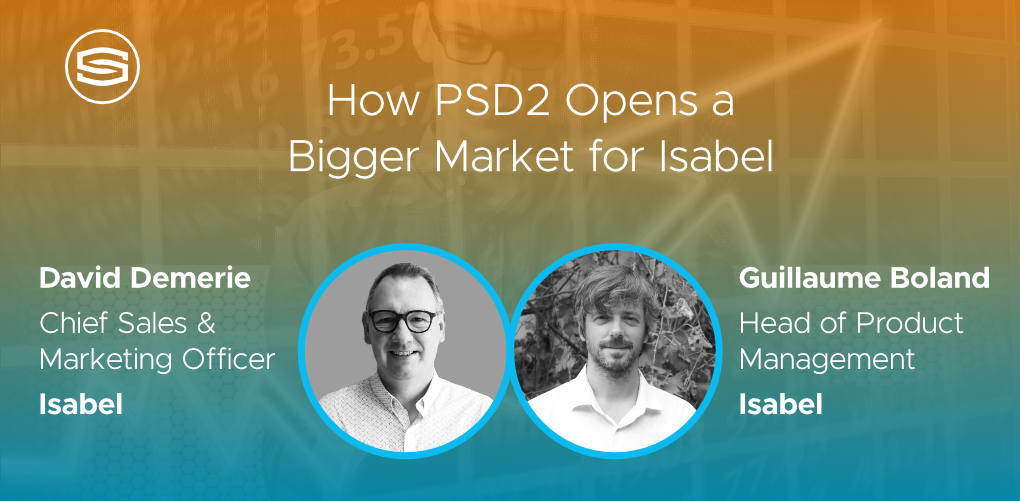
In my virtual room, we invited David Demerie, Chief Marketing and Sales Officer at Isabel, who also brought along Guillaume Boland, Head of Product Management at Isabel. Welcome, David and Guillaume. Maybe a first question. Ten years ago, banks feared the impact of Open Banking on their business model, and I remember it because I was working on payments at a bank. I was having meetings with Isabel to see how we could avoid that.
How did PSD2 actually affect Isabel's own business model? Isabel has, as I said, been something of an Open Banking provider avant la lettre for many years in Belgium, especially for corporates.
David: Well, it's an interesting question, and I'd like to make an analogy. Ten years ago, I was in a different part of the payments industry, specifically in card payments. When I started my career there, one of the first things they said to me was: 'Are you sure you want to pursue a career in the cards business? Cards are very likely to disappear in the next few years. They will be disintermediated.' And if we look at the card business today, it has never bloomed like this before.
Changing customer behaviour is something very, very complex. I think we can draw a parallel with Open Banking as well, where 10 years ago there was a massive scare. What would it cause? Banks would be disintermediated, new business models would emerge, fintechs would take over the world. What we've seen is that Open Banking has created opportunities for new players, but also for established players.
And it's taken quite a few years for the model to become embedded in the economy and on the bank side and the business side. And that's basically what we're seeing. We're seeing a development that started ten years ago, which was, let's say, Open Banking avant la lettre in the Isabel 6 world, before we were active in the PSD2 world. But the massive change that many players anticipated actually never happened.
Guillaume, you haven't been there for very long. Nevertheless, I can imagine that you've also seen or heard from colleagues how Isabel has evolved. Is there anything relevant you would like to share in this context about how PSD2 changed Isabel's model?
Guillaume: I think about ten years ago there was a wave of panic when PSD2 went live, and people worried about the threat to business. However, thanks to Isabel’s resilience, we managed to respond effectively. We weren’t just defending our position; we also developed a product aligned with the upcoming market demands that PSD2 would create, and API-first.
So, ten years after the PSD2 discussions became very concrete, how do you view Open Banking today? Would you say it’s a success, a failure, or somewhere in between? What’s your overall assessment of PSD2?
David: I would call it a very interesting evolution, actually, because with Isabel 6 we had a product that was essentially Open Banking avant la lettre, based on our own rails and our own connections with the banks. And what we did over time was build value, because the banks had data, and we had businesses requesting or needing that data, including payment information and payment initiation, and that is what we built.
Isabel 6 is basically a platform that was Open Banking avant la lettre, to which we added a large amount of value. When we saw PSD2 arriving, it was a fairly simple interface for exchanging basic information. And what you see is that the market has not yet evolved beyond that point. It's still the exchange of basic financial data without actually creating the value on top.
Guillaume: To clarify your question: let's define what success means. Nobody typically states, 'I'm doing Open Banking.' For me, success lies in practical outcomes. I've never heard a company explicitly say they're engaging in Open Banking, but I believe success in this area is when, for example, they can access their balance and reconcile invoices. These are the indicators of success for an infrastructure. Therefore, in that sense, Open Banking can indeed be considered successful.
David: Yes, it effectively filled a market gap. Looking at our historical customer base on the Isabel Six side, it mainly consists of businesses with complex payment requirements. They need specific features that PSD2 or Open Banking currently don't support. Conversely, Open Banking has created a new market, especially for pre-accounting software like ours, where access to Open Banking and account information significantly enhances the offerings of various players.
So, thanks to PSD2, you also have more clients now?
David: Absolutely, what we've observed over time is that Open Banking has branched into multiple directions. Some companies mainly focused on the consumer side, developing account-to-account payment schemes. In contrast, we drew on our traditional expertise in the B2B sector. Over the past few years, we have built an extensive network of over 200 software companies, connected with us, enabling their users to leverage Open Banking data to enhance their services.
The European Commission's primary assessment of PSD2 focused mostly on customer adoption rather than corporate adoption. The overall review was sometimes quite critical. Consequently, they created PSD3 and PSR, which mainly target the Open Banking aspects initially outlined in PSD2. What is your opinion, and how do you believe this will influence Isabel in the future? Will it again have a positive effect? Will the standardisation introduced with PSR open up more opportunities for Isabel moving forward? This could be a very important question for Guillaume, the Head of Product Management at Isabel. Having seen the details of PSR, how do you think it will impact your model?
Guillaume: Currently, in the PSD2 environment, we're connected to nearly two thousand banks. However, these banks all have different interfaces, APIs, and standards, which makes aggregating their APIs quite challenging.
Additionally, we are connected to several partners who require specific types of data in particular formats. This necessitates parsing all this data. Therefore, the main challenge for us is the lack of harmonisation and standardisation, which creates a significant burden.
PSR will fix this matter. Now, for the banks, it's still another debate, right, because for the banks, PSR doesn't bring value, right? So today, what I see in PSD2 and further down the line with PSR is that it (sharing data through APIs) is still a commodity for the bank, so it's still kind of a mandate for the bank to do that, and they won't get any earnings from doing PSD2 or PSD3.
It isn't a value-add product, but it remains aligned with a bank's compliance scheme. However, I believe that for Isabel, this will positively influence how we serve our customers and support our partner community. Currently, for each API and bank connection, we must conduct a thorough analysis to parse data, among other tasks.
PSR will offer significantly more stability for the APIs, unlike the current situation where connections often fail unexpectedly during the day or overnight without us knowing. Although customers do report issues, and we have tools to monitor the APIs, these measures are still not enough.
What is the operational impact of that? Will you have another call later, or will you rely on fallback mechanisms?
Guillaume: There are fallback mechanisms. They are definitely there. When a connection fails, that doesn't mean all the data has failed or disappeared. The bank also has its obligations, so we can go back in the past and so on. But again, from an operational standpoint, that means a lot of work. And I can tell you the banks aren't too keen to make that a very high priority. I'm not saying it won't be done, but it won't be done with extreme urgency.
David: I’d like to add that in the B2B space, there is also a varying level of maturity regarding what banks view as a good user experience for their customers. Maintaining your Open Banking API allows customers to access your bank data in other environments, which is central to the banking customer experience. Some banks are highly mature in this area and strive to keep their API operational 100% of the time to ensure an optimal user experience. Others are less convinced and tend to follow the flow, as Guillaume explained. It's our responsibility to monitor and ensure API stability.
I understand. I interviewed both Belgian and Dutch players. When speaking with Belgian banks, they mainly emphasise consumer-facing PSD2-related aspects and relevant use cases, but these go well beyond corporate applications, as that area is handled by Isabel. In contrast, Dutch banks often seem most proud of use cases that Isabel has already covered, based on my conversations with them.
Looking at your customers, where do you see the most value from Open Banking today?
Guillaume: Indeed, when you see Isabel 6 as a product, you have to understand the personas behind the users of Isabel 6. They are large and mid-sized companies that use multi-banking services and use Isabel as a product.
The value of PSD2 lies in its large target market, which includes even very small companies. To access these smaller businesses, an aggregator is needed, which is why we are partnering with others who focus on one-person companies and similar entities. PSD2 has truly expanded our market opportunities.
Previously, we primarily targeted those with Isabel 6 connections, but now even a single-company bank account can benefit from PSD2's offerings, significantly enlarging our potential market.
Alongside PSR and PSD3, Europe is also debating FiDA. There's still debate about its scope and how it will be rolled out. But looking at the current state of FiDA, I don't know how far Isabel wants to go in grasping those opportunities, because it goes, of course, far beyond payments. But do we need it? And if so, do we need it in its current form? Is there anything you'd like to share about that?
Guillaume: Yeah, okay. Regarding FIDA, we're not there yet. We'll see how it develops, but I believe we will generally need FIDA. Still, probably not in its current state. To clarify, it doesn't make sense to me that I can share my current account but not data from my pension, insurance, or similar accounts. That doesn't add up. Today, I can share my current account details and other data, so this disparity seems illogical. When I say not in the current form, I mean because Open Banking isn't fully developed yet. For now, we have PSD2, and PSD3 is upcoming.
Maybe PSD3 will address some of the issues we faced with PSD2, which is understandable. However, it's not finalised yet, so creating new regulations while the current ones aren't fully settled concerns me. That’s my main issue. Still, I see opportunities in Open Finance, which is a step forward from Open Banking. There are opportunities. We are currently discussing and exploring them, but since FiDA hasn't been voted on and remains under negotiation, we're not there yet. However, I am confident that opportunities will arise.
Another relevant and important topic, I think, is AI. We can't have a day without using or talking about AI. Do you think the emergence of AI is making Open Finance more important, or perhaps exposing how far behind the industry really is? After all, AI shines or falters with data. Open Finance has a lot of very valuable data. But maybe the Open Finance models we see today are not enough to deliver the sharp intelligence that AI promises.
Guillaume: Yeah, for me, AI isn't creating new requirements; it’s just made the old requirements more urgent. So data quality, consent, audit trails, everything now needs to be thought about in a way that tomorrow AI will be able to speed up the entire process. With the caveat, though, that I do think AI can do a lot of things.
I believe there will always be guardrails in place, and this is my perspective. Human oversight will always be involved. For example, AI can enhance data quality, handle granular consent, and manage audit rails. However, I think that the trust layer—covering identity, mandate, consent, and liability—will still ultimately rest with humans.
I included this in the interview because I see a good example in the United States, where a major AI company partners with a leading bank to establish standards and premium APIs. This collaboration could drive industry-wide adoption of these standards, potentially leading to a future where AI sets industry standards—considering regulation, of course. Such a development could have a significant impact if you think about it this way.
Guillaume: I believe that, if I recall correctly, it's MasterCard that first launched a payment execution with an AI agent. We're mainly discussing protocols and standardisation, but I want to emphasise that, in my personal opinion, the trust layer is crucial.
That trust layer needs to be more robust in the future. Therefore, everything related to identity, consent, and liability should stay as it is now. The evolution is progressing exponentially, and everyone agrees on that. I also believe regulators will need to play a significant role in this area.
David: There are two components to this question, because on the one hand you mention AI, and on the other hand you mention premium APIs. What's lacking in the current PSD2 world is a business model, because banks have to open their doors and make their data available, and there's no business model behind it. So there's no driver for them to actually push use cases or support any developments on that side.
We believe that in the future, banks will recognise the potential of Open Banking rails to unlock value. I think it's only a matter of time before they see the benefits of developing a compelling business model in this area. Then you will see real innovation kick in.
The remuneration is the part that's lacking for the moment, because, as Guillaume already said, we are now pretty much in a commoditised market for Open Banking data, whereas the whole premium segment, the premium APIs, is where the real value will come from.
That's what I hear a lot in the other interviews as well. One last question: What are Isabel's next steps on the journey towards Open Finance and embedded banking that you can already share?
Guillaume Boland: We are now closely examining the upcoming regulations, including PSD3, PSR, and FIDA. We have a lot of preparation to do for these changes. We want to position Isabel as a trusted data-sharing platform, where you can not only access account information but also prepare for future regulations by embracing the Open Finance ecosystem. This is where we want to move forward now.
For 10 years, we have moved from asking where I can access that data to asking how I can prove I was allowed to access it. I think this is a paradigm shift. This is really important to bear in mind, because I'm going to repeat myself, but everything that relates to consent or the granting of permission to share the data will be paramount in the future of what we want to build at Isabel.
David: It's actually a good question because I want to tie that to something else. We've seen a big uptake in Open Banking customer engagement on our side, driven by something completely different: namely Peppol (Pan-European Public Procurement Online) and the e-invoicing obligation that went live at the beginning of the year.
So what you see is that the entire business ecosystem in which businesses operate is starting to work more and more in what I call an embedded way. Every business, whether big or small, is using some form of ERP or software package to manage its business. And Open Banking has slowly found its way into it. But Peppol is actually a catalyst in that, because all of a sudden.
You get invoices into your trusted software package that you use to manage your day-to-day life. And all of a sudden, financial data becomes increasingly relevant because you want to have that account information and be able to initiate payments. So on that side, it's a catalyst. And for us, with the network we have built over time with the plus 200 partners we now have, we think we have a very strong asset in the market to, on the one hand, link banking information, banking in general, with the business environment in an embedded way. And I think we still have a very bright future ahead of us in that space.
That makes a lot of sense. I think the use of Peppol also made reconciliation, etc., much easier. It forced people into a new way of dealing with invoices, but I think the impact went way beyond just making sure the government has access to a copy of it. So no, I completely agree with you on that one.
And to elaborate further, another observation is that fraud is also increasing rapidly. We have been operating a platform for 30 years, giving us extensive experience in managing fraud and recognizing relevant patterns.
I think this should translate to the Open Banking world as well. It's not just a question of transferring data. It's not just about initiating a payment or accessing other financial data. It's also a question of trust and security, as Guillaume already mentioned. And I think the main differentiators in the future will come from the parties that can do this in a secure and orderly manner.
All right. Thank you very much. Guillaume, David, I appreciate your time. Looking forward to sharing this with the entire community.
The Banking Scene: Director's Cut
If you prefer to grab your favourite beverage, kick back and watch or listen instead of reading, you can view the full interview below or follow along on your favourite podcast channels here.