
Insights & Opinions
How ING is Using Agentic AI to Streamline Banking Operations
Fri, 26 Jun 2026

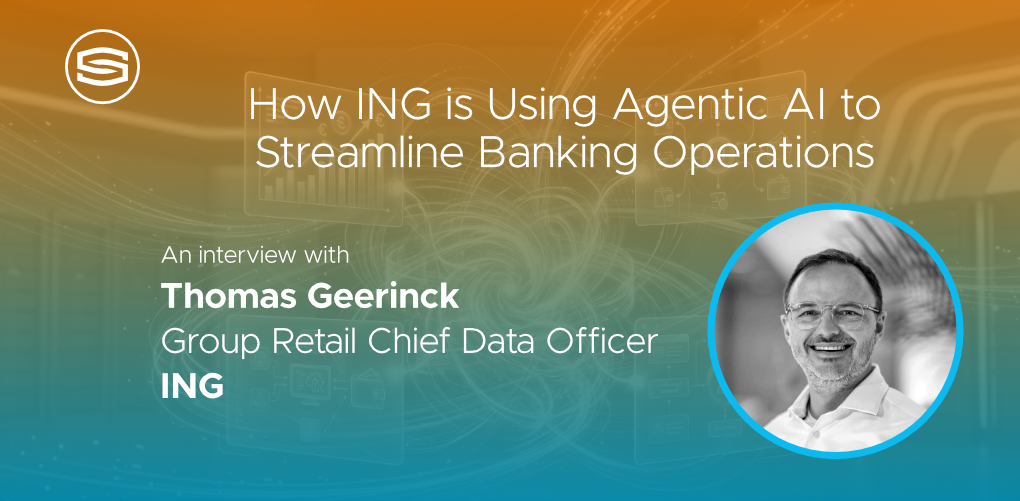
In the context of The Banking Scene’s research on how Benelux banks view the evolution of AI and Agentic AI, we organised multiple panels and presentations at our events, as well as a couple of highly engaging round tables with industry executives.
On top of that, we decided to speak directly with a couple of key industry influencers to pick their brains and get their vision. Thomas Geerinck, ING’s groupwide Retail Chief Data Officer and, in Belgium, also Head of Data and AI, was one of them.
Thomas, welcome. We've been inviting speakers from ING to discuss AI for several years. The first was about Gen AI, and now it's about Agentic AI. How have you observed this evolution from your perspective?
AI is nothing new for ING, nor is it in the banking industry. But if you think back to the past 10 years, we saw the progression from advanced statistical modelling in the risk context towards the first machine learning techniques, and, with the scaling up of computing capabilities, those techniques became more complex. And then, of course, it moved into the first machine learning techniques, advanced analytics, and the first AI neural networks.
You've seen that evolution up to a point, and in a banking context, mostly in 2023, with the advent of Gen AI and the first real Generative applications, when everything started to change. Suddenly, we noticed and realised that AI brings scale. And in terms of deployment, the value is that you build it, you deploy it to the maximum extent.
For ING, this means building it centrally with a team of people from various countries, regardless of their location in the head office and we try to replicate our developments across all our markets and geographies, and across departments: in the retail space, in the wholesale banking space, in the business banking space, in the consumer space, to leverage that scale.
And that's our strategy to date in AI. We're not in it for the marketing stories about 1000-plus use cases: our quote is that 90% of the real initiatives we strategically pursue must be scalable.
A very recent example was big news in the Netherlands on the usage of AI in the mortgage application process.
Yes, true. In the Netherlands, our home market and the biggest market for ING, we developed the full back end, so the non-customer-facing part, in an Agentic way, as the first bank to do this.
The entire process, so the application, the required documents, the salary slips, the collateral, the home documents, its processing, the risk profiling, the assessment, and the preparation of the mortgage files, so all but the client contact, is fully done in an Agentic way in the back end. It all basically serves our brokering and our commercial channels facing the market.
Which I think is incredibly interesting because, most of the time with Agentic, we talk about efficiency, but this goes much further: it makes the customer's life easier and delivers faster response times.
I can imagine Gen AI; it was more about sharing the right prompt, etc., across the organisation. Now, with Agentic, we start with assistants, which creates more opportunities, but I can also imagine many more challenges in making sure everyone stays aligned, no? What's different now compared to the early Gen AI phase, proof-of-concept efforts, and internal assistants, according to you?
I wouldn't consider these different phases. What we see today in this rapidly evolving spectrum is a set of congruent streams. You still have the majority of people who need to boost their AI literacy. For them, the first contacts with prompting and the first contacts with a Copilot are still the priority, and I’m not even talking about Copilot Studio or IT-integrated AI tools.
The majority still needs to get their hands dirty, become more AI-literate, and get a sense of what it means to have some typically minor productivity gains, time gains, effectiveness gains or quality gains for themselves. We are still in that phase, essentially the one of issuing licences to everyone, but that's the easy part.
Then, of course, we need to nurture that licence. We need to work out how to use it and how to provide the right tooling, guidance, and training. So that full phase of AI literacy, “Citizen Development”, as we call it, is still in full swing. We are, for instance, now having tens of thousands of licences around ING. We have launched the full programme “AI4ALL”, and we are tracking and we are giving everyone the chance to jump on board.
Our biggest challenge is ensuring everyone in the organisation has the opportunity to be prepared for the future.
Next to that, we see the evolution from assistants, productivity assistants, which are then scaled within a smaller operational context or within a team now evolving into simple, complex, or even full Agentic workflows.
Why do I make that distinction? It's the workflow concept of orchestration. In a simple workflow, it's simply a chain of events. And you could argue that the Agentic mortgages case in the Netherlands has components of all three. Not everything is fully Agentic. There are also predefined terms, predefined parts, and predefined logic under the hood.
Having it fully Agentic would mean you have an orchestrating agent that decides, based on all the inputs and interactions with the outside world, what to do next.
That brings me to my next question and one my colleague Andrew Vorster often starts with in panels or interactive dinners on Agentic AI: what qualifies as Agentic AI in banking? The definition of "Agentic" can be misleading and is often abused.
In general, Agentic means being able to interact with the outside world, with clients, with events, with bankers, with employees, but outside the strict operational world of our bank. And that Agentic part is about making decisions based on the tools that the agent has at their disposal.
If I take, for instance, a conversational banking context or a mortgage context, we foresee those agents having a number of skills, a number of tools, and a number of call-outs to the systems we have in the bank. Most of it is predetermined.
In the mortgage context, it's about document processing and intelligent extraction, followed by a couple of decision frameworks; those are the skills at the agent's disposal, nothing else. There are many guardrails in place.
In conversational banking, Agentic is ultimately about creating better customer satisfaction and a better NPS, and it can go in two ways. Today, the chatbot typically gives you a pointer. If you want to check where your new card is, please use that link. Or, if you want to change your PIN, please go to this page in the app.
So, it's not taking any action, it's guiding you.
Exactly, it's providing information, but it's not really fulfilment. So a first level of Agentic would be to do it for you and provide you with the information that gives you the full end-to-end experience, the full fulfilment of that request, whether through information, execution, or both.
Execution, like: please block my card, please order me a new card, please execute a wire transfer, and so forth. That's the execution part we're moving to, and I think that's the next phase we're in. That Agentic conversational component is client-facing and fulfils an information request in full or an execution request in full.
How often do you see the confusion between proper automation, which we've seen for many, many years, and genuine agents?
Yes. At ING, we have a couple of nice pictures there because the creed is indeed AI-first in mindset. And in everything we do, we consider how we can optimise it with AI. The end result is not that we must use AI for everything. The end result is often to start with automation. Automation is basically smart scripting, a sequence of steps to follow, but in full control, fully traceable as well.
Those are the boundaries from which we start, with full automation. Of course, Agentic is when we start generating with Gen AI, and that becomes partly predictive. And we should never forget this: it is still always predicting the next pixel, the next word, nothing else. That component cannot be forgotten. And that's why the element of control and the AI risk journey are very, very prominent.
Which banking workflows do you consider realistic candidates for Agentic orchestration first, and which ones would you consider less attractive on the spot or look attractive on slides but are poor candidates in practice?
We follow the industry a bit, and we see the most obvious candidates in terms of workforce are coding and operations. Then you have the product operations and the service operations.
The generation of code is the most obvious one and now proven, not only in banking but across industries. I've seen numbers ranging from ten per cent gains to up to seventy, and some claim more.
We are not at that stage yet. Still, banking has a large legacy of older systems and older technology frames. And that migration effort or continuous lifecycle management of your tech stack. It’s in that context that these Gen AI frameworks and these Agentic coding frameworks really mean an acceleration.
And so I think we're just at the beginning of that, to try and see that happening.
Can I say that in the coding part, the benefits are coming mainly from Generative AI, or is there also an Agentic role?
I believe it is both. We started with Generative AI as a coding assistant for all our engineers. Now we're taking the next step: if you have an older legacy application that you want to bring into newer language frameworks, for example, from COBOL to Java, we have now developed, as a first step, an Agentic coding framework that can cut development time by more than half when moving from the old application to the new one.
So, in a traditional way, we had foreseen, and it's a real case, developing a new application, a couple of thousands of lines of code, into more modern screens, a new technology basically. We had foreseen 10 to 12 months. It is now done in four to five months, including end-to-end, real testing, including the screens, everything.
That means that the revitalisation or rejuvenation of our tech stack, which is an ongoing process and costs a lot of money, can accelerate significantly. It also means that new innovative features that require changes to our products and our tech stack can be developed.
Let me give you two more examples. We have product operations, such as the processing of a consumer loan, and service operations, such as the KYC process, where today a mix of Gen AI and classical machine learning models is applied across the end-to-end journey.
Previously, KYC involved extensive customer data collection, including detailed data points, followed by transaction and behavioural analysis, due diligence, and alerting. Currently, this process is becoming much faster, event-driven, continuous, and triggered by all kinds of models: data actualisation with data retrieval, semi GenAI, behavioural modelling with classical machine learning, customer due diligence with machine learning and a risk assessment, plus summarisation.
Today, we are starting to see a fully connected end-to-end flow.
The same principles apply to product operations in consumer loans: the underwriting model, the origination package, fund release, follow-up, early-warning system signals, and so on. Overall, it is a comprehensive process that is increasingly integrated with machine learning and Generative AI, though it is not yet fully autonomous.
Organisational change doesn't pause any more, does it? When I started at the bank (in 2007), it was way too slow. We had about two releases a year, maybe three, and right after a release it was calm, and then you had to speed up for the big change. But these days, it's constantly changing and seems to be getting faster and faster.
You’re right, that is also my observation.
What characteristics make a workflow agent friendly, according to you? Are they stable rules, a strong audit trail, low discretion, bundled tool access, or something else, maybe?
In my opinion, agent-friendly means you need to be able to develop the agent. Developing an agent is about setting the right guardrails, defining the right data model for the agent to use, and selecting the right data: not too much, not too little, but it also depends on the quality of the data. This can be very parameterised from a database, but it's mostly also work instructions, process instructions, and role descriptions. Essentially, it is a matter of setting the tasks or the set of mini-decisions that an agent or a piece of code can make.
That is the majority of the work. Typically, the processes we have documented have multiple versions, and the work instructions are available on our SharePoint. These have been updated, obviously, but they are not necessarily agent-friendly. They're not necessarily translated into skills, tools, or roles.
The key measure of progress is the effort to adapt these processes for AI and agent readiness. As a universal bank, we have numerous journeys, products, and related processes and work instructions. All of these elements contribute to the overall effort.
Let's dig a bit deeper into those guardrails, the limits you set for an agent. Where do you place the hard boundaries on autonomy for a machine that is replacing human work? And what actions can AI take without human approval today, if any? Because, of course, we are in a very trusted environment, banking, we need to be careful there.
I dare say there are no Agentic frameworks, and not even AI or machine learning models that operate without a human in the loop.
For example, in a fraud context, which is the primary context in which AI was used in banking, every potential fraud case is flagged. In that context, the threshold for false positives is very, very, very broad. We need to look into these because the chances that something might be wrong are really affecting our clients. So there is a potential risk to our clients, and, as a consequence, the potential value added by these triggers is huge. So we need to take it seriously.
Obviously, in a KYC context, we need to balance it against the real risk to our client, the temporal effects, and the change. You have these concepts of the triggering model and the judging model, which, as an intermediate step, try to judge what we saw and what we can learn from it, as a somewhat contradictory analysis, before it comes to the human employee.
Now that we are moving more into Gen AI and Agentic AI, the idea of using Gen AI or an LLM as a judge, a filter, a slowdown mechanism, or an explainability mechanism is being actively explored. But as a consequence, we need to learn and make sure we can also explain this to the regulator. We now have this evolution of these models.
We have to have a thorough debate with the regulator about what this means. How do we treat this? And how do we show that it works? So those guardrails are crucial, and today nothing functions without a human in the loop. Not on the commercial side, not on the risk side.
Well, guardrails and probably also audit rails to make sure you can explain what happened afterwards.
That's one of the key requirements in major decisions like loan approval, client onboarding, or offboarding: it must be explainable. We aim to manage that effectively.
Could you already predict which decisions should always be made by humans? Not necessarily because the model is weak, but because accountability shouldn't be delegated? Or is this an ongoing process, and we'll just find out later - maybe in five years?
I don't have a crystal ball, and making predictions in this field is very dangerous, but okay. There are a number of moments of truth that are super important in people’s lives, both mentally and psychologically, where we consciously decide how to balance AI interactions with human interactions, and I believe that this perspective will ultimately prevail.
You get married; you buy your first house; you have children; you have a fundamental problem in terms of fraud, and that affects you in a life-changing way… In moments like this, it will always be valuable to talk to someone or find someone to trust. And that is just in the consumer space.
The same applies in an entrepreneurial context: you've just founded your company, you've just succeeded in a first takeover, and those moments will continue to exist.
In those moments, banks will need to keep trying to delight the client or to ease the client's situation with the right service and the right advisor.
That was also one of the conclusions we reached at an Agentic AI dinner we hosted earlier, with the mortgage service as an example. The logic aligns with other financial institutions’ visions, and it will be interesting to see how it evolves.
ING has been one of Europe's most vocal banks on scaling AI beyond experimentation. Which AI deployments have generated the most tangible business value so far? And where has it been more challenging to demonstrate a clear return on investment?
Let me start with a no-brainer: in the fraud space, the value is not for us but for our clients. The value lies in trying to capture money laundering, phishing attacks, and so forth. Let that be clear.
If you try to measure the workloads of people doing quite repetitive tasks, as there is in a KYC context, for instance, then translating that into an impact on the FTE doing the work with a model is doable.
Every so often, we need to do a full due diligence review, which means a peak in workload. In that context, it helped us keep running our business during these peak moments without affecting other business-as-usual operations. You cannot simply upstaff 5,000 people for X amount of months and then let them go and then find another work or move them from work to work.
So in KYC, we can certainly say that the AI models have proven their value. They may not have led to an aggressive reduction in the current workforce, but they allowed us to keep our license to operate and make sure that we cover all due diligence and transaction monitoring for all our clients.
Where ROI is more difficult to measure are the claimed commercial advantages. Measuring how much more productive or commercially effective a banker became, or how much more attractive or commercially effective a campaign became, and attributing that effect to the AI model that is somewhere underneath, could lead to analysis paralysis and very difficult debates.
In this case, we (at ING) rely on our common sense and set our ambitions. Strategically, we define the right approach: transitioning to a conversational channel and integrating an AI suite to support our private bankers in investment scenarios is the right move. We set a figure for how much we believe it will contribute to our growth.
We will not try to reverse the calculation or explain the impact of AI. I think it's the wrong debate. As a consequence, the commercial targets remain with the business. The analytics and data department are there as a partner to these commercial departments at ING, but not as a challenger to dictate how much they should increase sales or cut costs.
Where have you seen the most challenging aspect of demonstrating a clear return on investment these days? You often see that, especially in programming, too many tokens are used, and suddenly, AI becomes more expensive than humans. I don't think that's happening at ING already, but are there some examples where it became much more challenging to find a business case?
We now see it coming with more complex conversational use cases, where we must ask ourselves what is the effective token usage? And it's on that trade-off that it's being played today.
In a coding context for an individual engineer, I've also seen articles where you say that the best-paid engineer is equivalent to two or three times the token usage, and that you only need a couple of them to operate a full factory, basically. We're not there yet in our context.
But, for instance, in that complex code migration example I gave earlier, the token consumption, if you do it in a smart way, isn't the hurdle. The hurdle will probably be bringing new innovations to market faster and redoing, redoing, and iterating for the sake of iterating.
There's probably a pitfall where we will have to move to a token quota per engineer and very strong FinOps, which we are setting up as a priority now, by the way.
By FinOps, I mean measuring and monitoring our usage, how it evolves, what it means, and the types of models we use. We deliberately maintain a whitelist of a limited set of models, the right ones, different in terms of size and providers, and the combination we believe is the right one. This is a constant process of evaluation and learning.
In a broader context, AI is a dominant US technology these days. We talk a lot in Europe about sovereignty. What have you learned about model choice and sovereignty in a European banking context when it comes to AI?
We cannot deny this debate. We are quite dependent on US providers, not just in the context of AI models but also in the infrastructure. Today, we see a slow change or at least an evolution. Our tech department is closely monitoring a couple of initiatives, and we are trying to bring that sovereignty to Europe in terms of infrastructure.
It gets a bit more complex when we look at AI models, where the number of non-US providers is very sparse. I'm excluding China for the sake of simplicity here. We are currently using US models and closely follow developments in available European models. But you see that it's difficult to keep up with them.
The speed of innovation is extreme here. And so we are bound to follow the evolution from US providers. So we are on that path.
Over the next twenty-four months, what do you think will separate the banks that genuinely operationalise Agentic AI from those that remain stuck in the demo mode?
We think it's all about scale, at a global level, so multi-geography. If you think about the successful players in financial services, some of them are incumbent banks, some are highly aggressive fintechs or neobanks, if you will, not always having the full offering, but still very aggressive, very well positioned, if you think about it. They have scale by design.
They have a single platform, single development, single product offering, single way of approaching a client, single type of journey, single type of interaction. And so the speed at which they implement AI, or Agentic AI, in client-facing functions as well as internally, that's really where the difference will be made, in my opinion. And then it comes down to the right resources.
And the right resources, in terms of AI engineers, AI ops, BusDev ops people, and the super analysts and super engineers who can work with Agentic AI. And let's be honest, that is a constraint. Not only at ING, I think it's in all industries and in all types of companies. I would argue it's even in the neobanks, as it's new.
So, combining that constraint on the right resources, the right workforce that knows how to operate and build this, with a global deployment model, multi-geography from the start, I think that will set apart those that will make it from those that will probably need a bit more time or lose out.
Maybe a final question. You have already hinted at this a few times. Which role in the bank will change most, according to you or to ING, because of Agentic systems? Are you looking at operations managers, product owners, risk teams, architects, frontline staff, the middle management?
That's a bit of a difficult question, and let me explain what I mean. As I said, there will be global, scalable AI platforms operated by the core teams, with an operational component alongside them.
I believe that because of boundaries between countries, between different lending products, or between client segments, those boundaries become much blurrier.
Today, in operations, for instance, we organise ourselves nicely for mortgages within market X, mortgages within market Y, mortgages within market Z, and so forth, or for business lending across different markets in an operations context.
The consequence of the evolution I just explained will bring these different product groups much closer to building Agentic capabilities into a lending factory, in this case.
A lending factory with AI platforms and AI-savvy people that are operating the human component next to that.
It's as if I've heard that story before, ten or fifteen years ago, when mobile was rising, that everything would become blurrier and that we'd all start using the same approach, etc. But you still live in a specific context with very specific national laws, local culture, habits, etc.
That may be right, but today, in the COO world, it is very clear that this will have a massive impact on how we are organised, how we deal with technology, and how we deal with our clients and interact with them.
Also in the technology world, we expect an acceleration in engineers' skill levels, and we might need more of them to keep up with the pace of change, as well as to manage and maintain these Agentic factories once we’re there.
A third component is the product, where we need to rethink how to manage that. What does it mean then to own a product? It means you're in charge of both the value proposition and the way we deploy it or build it – in the Agentic way this time - but also the way we operate it towards our clients, again in the Agentic way. That means that also product ownership end-to-end will completely change from the way we look at it today, and also way more difficult to segregate.
This interview is included as a reference source for our white paper: "AI and The Agentic Future of Banking", published in association with Cognizant and featuring exclusive interviews with senior banking executives, technology leaders and AI experts, together with insights gathered through The Banking Scene's research, think tanks, industry events and third-party papers, which you can download on the link below.

The Banking Scene: Director's Cut
If you prefer to watch or listen instead of reading the transcript, you can find the full interview on YouTube below or on your favourite podcast channel here.