
Insights & Opinions
The Evolution of Open Banking: an Interview with Joris Hensen of Deutsche Bank
Mon, 03 Aug 2026

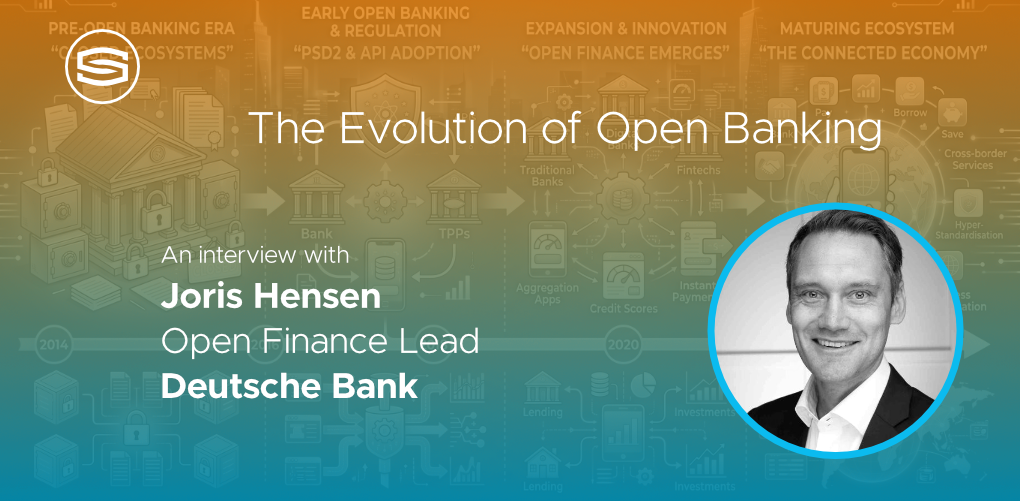
Over the last 10 years, Open Banking and Embedded Finance have sometimes felt like a movie series that never ends where episode develops the plot a bit more, but the story still doesn't feel complete. During this quarter, I am interviewing industry experts for our next white paper on Open Banking and Embedded Finance in Europe to understand the Benelux perspective on regulation, sentiment and the road ahead.
I recently had the pleasure of interviewing Joris Hensen, Open Finance Lead at Deutsche Bank, and a familiar face to many members of our community who have met him or seen him on stage at our events.
Welcome, Joris. We have had you on a few occasions for The Banking Scene interviews and at events, and we meet every once in a while at third-party events. For our audience: Joris was the co-lead of Deutsche Bank's API programme, and today he is the Open Finance Lead at Deutsche Bank. Welcome again. Good to have you with us.
Thank you, Rik.
I think it's close to ten years since you and I have been discussing open banking and PSD2. If you look at PSD2 today, or open banking more broadly, would you consider it a success?
I have certainly seen an evolution. The first time we started to speak about open banking, it was, I would say, the beginning, the starting point, around transaction data and additional data.
And now, seeing, for instance, what happens in wealth management and other areas, particularly on the corporate banking side, I would certainly say it's a success, with great use cases.
Is it already where it could have been? Probably not, but it is certainly a good starting point for the future, I would say.
We've already discussed some of the use cases by Deutsche Bank in the past, but what would you consider the most successful use cases today from the open banking ecosystem for Deutsche Bank?
Wealth management is an incredibly interesting area, offering information on shares and a customer's portfolio, as well as investment ordering. That's something really unique in the German market.
There's only one other bank offering this kind of information through an API. I
It's successful because there is a clear business model, and it's a very interesting target group you could use the APIs for. There is market demand in this area, so wealth is definitely one business line worth mentioning.
But I still consider the embedded finance APIs to be very important because they lay the foundation for fully digitised processes and adaptability for what's ahead, basically.
Can you make that a bit more concrete? What are the concrete use cases you're thinking about when you talk about embedded finance?
It's mainly about embedding your banking products into third-party platforms, like Check24, a comparison portal where you can open an account immediately. It's really straightforward, and it gives you something that is reusable for other contexts and maybe more specialised use cases to come.
Especially the first part of your answer is very interesting. I was always surprised to see Koen Adolfs from ABN AMRO combining open finance and wealth management. But hearing your story suggests it is not a coincidence at all.
If we look back at open finance of open banking today, according to you, what did we get right and what did we get wrong?
What we got right is that open banking is a huge opportunity, something to work on, not only for the sake of having external use cases, but as a way to modernise and prepare your IT infrastructure for the future through APIs.
What we also got right is to see APIs as an opportunity to build products and to see the product dimension of them.
What we got wrong, or maybe I, what I've always felt, is that it certainly takes more time to prepare the infrastructure to be able to expose more APIs than we originally thought.
Do you think that setting up the infrastructure in a timely way will work better with PSR, the next chapter? Will it solve what we got wrong with PSD 2?
From what I understand, it's mainly aimed at preventing fraud rather than adding new features. I believe the proposed FiDA regulation will cover more topics because it includes a broader range of data and offers more APIs.
Which already answers my next question. Do we need FiDA? Probably yes, but if so, do we need it in its current form?
That's a good question, and I guess it depends on who you ask. So, very interestingly, at Deutsche Bank, we put together many experts in Frankfurt to do events called the FiDA Roundtables, where we had banks, insurance and tech companies. Even The Banking Scene was at the flagship event, even attended by our former CIO, underlining the importance of a data-driven business.
At those round tables, you could meet a lot of people who are in favour of the scope and the broad setup.
For those who are not familiar with FiDA, the regulation would introduce a very wide range of new data points, such as pensions and insurance, covering essentially all data related to retail and corporate customers, at least small and medium-sized corporate customers. So that's probably pretty interesting.
There is a lot of criticism around the other idea that FiDA would introduce, namely, schemes. So data would be exposed through schemes. Banks could also monetise the data. Those schemes would establish the operational boundaries. But many people are afraid that we would end up with a lot of localised, product-oriented schemes, so that by the end of the day we have a huge fragmentation in Europe, with different standards set by the different schemes.
So one of the discussions at our events was about how to avoid that and to what extent there should be governance to ensure a coherent approach.
I see, and indeed, I can imagine the next question gets who will govern that framework, of course?
That's true. And what I've been hearing all the time as lessons learned from PSD2 at these Roundtables is that it's also terrible to end up with a lot of interfaces that are theoretically there but not really working, and that we need to make sure they work and operate as they are designed.
In the context, it was interesting to find another European-funded initiative called FAME (Federated decentralized trusted data Marketplace for Embedded Finance) is a European Union-funded Research and Innovation Action under the Horizon Europe framework. It’s working on Europe's first decentralised marketplace for embedded finance (EmFi) data assets, allowing users to trade, monetise, and exchange datasets and AI models.
They define exactly how to bundle, combine different standards into one, build access, and handle monetisation. It's an approach originally driven by the EU, with many market players, mostly tech companies. But it would certainly be nice to implement such a standard or architecture.
Back to your point, who is governing? I believe we should at least make sure that something like this gets implemented, perhaps governed by an independent third-party body. But also look at it from a technological perspective. That's basically what I want to say.
It's now been two years since I expected FiDA to become a hot topic within financial institutions and at bank conferences. And for two years now, I've been struggling to find speakers. Luckily, I have people like you in my network. But I have the impression that the conversation around FiDA is either very complex or simply not there. How has the discussion evolved over the past years, according to you? And where do we stand with FiDA today?
I think there are very open-minded people who see FiDA as a possibility, not only among the FiDA roundtable we gathered, but across the wider industry. The development over the past two years has focused on understanding what FiDA could bring, what potential use cases could be built with the data, what roles the banks could play, and how it could benefit the banks.
In short, I’ve seen the conversation evolve from what this FIDA regulation is going to an understanding of how to get ready, what we could do with it, and what the ecosystem could build with it.
On the other hand, we have the development that the EU has been in the trilogue phase (since June 2025) for a while now, where they are discussing the different viewpoints among the member states. And my feeling is that the inclusion or exclusion of the tech companies, the gatekeepers, is still a big topic, for instance. It is an open question how this can be resolved.
I attended a conference last week in Berlin, where the discussion was about how we can build and prepare for open banking without regulation, or whether regulation will still take time to implement. And that was the one person on the panel who said that the market is already driving towards standardisation because companies, data aggregators, start to gather more and more data, and you could argue that they have already built a kind of standard, but as a service you would be paying for.
Did they also mention specific companies? Is it what I think it is? Are we talking about AI companies or other aggregators?
They didn't mention a specific company, but, for instance, what you can already see in the wealth management space is that companies offering data are starting to aggregate it from other markets.
If you had the chance to redesign FiDA today, taking AI into account, what would you change?
That's a good question. You could say that FiDA would deliver a solid foundation for AI, but what's the use case to start with?
First of all, I feel like the one learning I had also from the roundtables was that I would introduce something I call a sandbox. Maybe a test functionality, start small, but start in real life. I think it would be very interesting to understand what would be useful for AI, because it's actually a very interesting topic.
And I would design it to start with the use case, build something, see how it works, and then build on top of it.
With the emergence of AI, do you think it's making open finance a more important topic, or predominantly exposing how far behind the industry really is in Europe?
I think it definitely makes open finance a more interesting topic, perhaps not one of the key ingredients. After all, what does open finance do? It delivers structured data. And when we talk about AI tools nowadays, they don't want to consume market websites; they need structured data, capabilities, and a good overview.
What I find interesting is that nowadays we think of a product, you know, a banking product, as something a customer is just consuming or digesting information about it.
If you were using an AI tool, you would probably be prompting, "Okay, I'm opening my business. What financial services do I need?” and then thinking from both the problem and capability points of view. And I guess that's changing the whole interaction with the bank. And in order to respond to that, I think you're back to APIs.
Embedded finance, fully digitised processes that can be embedded, and to interact with those tools, becomes the most important ingredient for the future.
Alright, thank you. Maybe one last question, which may be answered from your more holistic view of Europe at large. Who is really driving open finance today? Is it the regulator, banks, fintechs, technology companies, AI providers, or the customers themselves? Who is key today in shaping the agenda for open finance tomorrow?
That's a good question, actually. Yeah. I think, certainly, customers, through the use of AI tools, are creating an incredible demand that is not comparable to anything seen in the past.
Certainly, the open banking enthusiasts out there, and probably the ones you have interviewed or are going to interview, are the innovators behind new ideas about what to make with the data and how to respond as a bank.
So I guess, at the end of the day, the short answer to your question is that it's going to be a combination of what's happening, the drivers, and people who understand the possibilities and drive this change as a positive outcome for the banks they work for.
Alright. Joris, thank you very much for the conversation. I look forward to receiving an update on open finance whenever necessary.
The Banking Scene: Director's Cut
You can watch or listen to the full interview below or find us on your favourite podcast platforms here (don't forget to subscribe!).