
Insights & Opinions
Three Things Keeping a Belgian Banker Up at Night in 2027
Mon, 02 Nov 2026
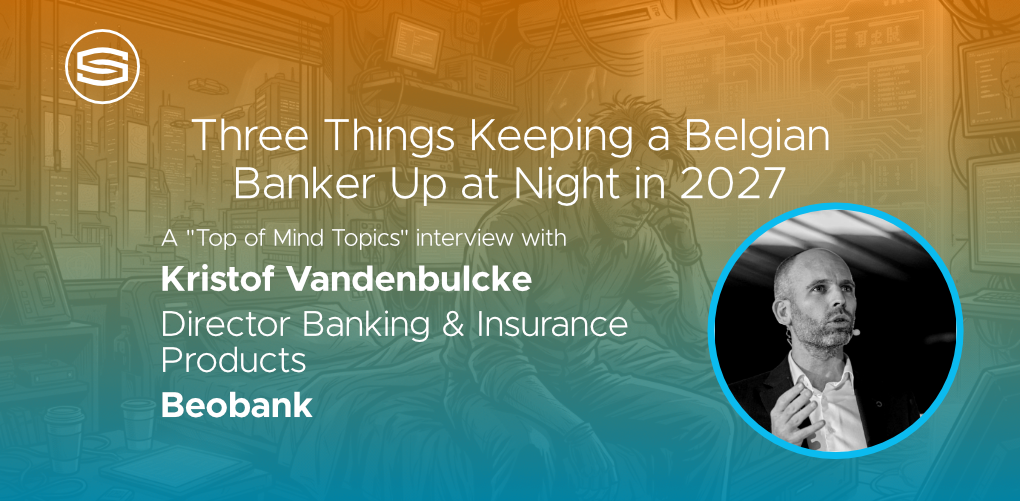
What are your top three topics as we head into 2027? I put that question to Kristof Vandenbulcke, Director Banking and Insurance Products at Beobank, in the first of our “Top of Mind” interviews. As I outlined in my approach here, I asked for three topics, counted down from number three to number one, and I channelled my inner Englishman by repeatedly asking "what?", "so what?" and "now what?".
What came back was not a list of fashionable buzzwords. It was a sober view from someone who sits at the heart of a traditional Belgian bank and is watching multiple forces converge on the same place: customer value, trust and the business model that depends on both. If you work in or with a Benelux bank, I suspect at least one of these will make you squirm in your seat.
The neobanks come of age
Neobanks are hardly news. They have been part of the European landscape for the best part of a decade, and in many boardrooms they are still filed under "second account, nice app, not a real threat". Kristof believes 2027 is the year that comfortable assumption expires.
His reasoning is elegantly simple. A retail bank competes on three fronts: daily banking, meaning how you pay and interact with your bank day to day; ancillary services such as investments and insurance; and credit, from consumer lending through to mortgages. Neobanks have are taking the lead on the first battle on speed, fluency and convenience. They are making real progress on the second, with robo-advisory and investment offers that compare well with what incumbents provide. The third front is where the game changes, and players such as Revolut are now investing heavily to bring mortgage and consumer lending propositions to markets including Belgium.
Why does that matter so much? Because in our part of the world, a mortgage is a twenty-year anchor. Once a neobank holds all three slices of the pie, it is no longer the account you top up for holidays. It becomes the primary relationship, and that is a far more daunting prospect for traditional banks.
I shared a personal anecdote here. Two years ago I divorced the legacy bank I had been with for more than 30 years, including a long stint as a premier customer. I had run a secondary account with a neobank for five years, grew tired of the friction and the dated app at my main bank, and used the UK's switching service to move everything across in a few clicks. Nobody from my old bank called to ask why. I have not looked back. Apologies to any readers from legacy banks, but this is a very real threat.
So what should incumbents do about it? Kristof's answer is to stand firmly on two legs. The first is digital: daily banking and much of the ancillary offer must catch up with the standard the neobanks have set, and there is no excuse for not doing so. The second is personal: long-term mortgage pricing is still won in conversation, where a bank can price sharply for each individual where it can earn the primary relationship. That is hard for a digital-only player to replicate, and it remains a genuine advantage.
When I challenged him on whether this simply becomes a race to the bottom on price, his answer was the most important point in this section. Pricing is the outcome, not the strategy. The real work is understanding precisely which customer segments you can create a genuine win-win relationship with, what those customers need and how they want to be served. Get that right and you know where you can afford to price low today, and how you will capture value across and beyond the life of a twenty-year instrument on your balance sheet.
AI, quantum and the currency of trust
Kristof's number two was, in his words, the buzzword of the last four years: AI. It would have been easy to stop there and nod along. What made his take worth listening to was where he went next.
He described AI as the first technology in human history that competes directly with our one of two unique qualities, intelligence. Emotion, for now at least, remains ours. If most people sit somewhere between 70 and 130 on the IQ scale, the systems we are building are already operating far beyond that range. Most organisations understand this in principle, and are busy working out how it reshapes processes, operating models and jobs.
The more unsettling point is the combination of AI with quantum computing, which promises to multiply that capability many times over. Our community heard Dharmesh Mistry make a similar case on stage in Brussels with his idea of "Quanvergence": quantum, AI, data and tokenisation all arriving at the same time. Quantum may be a little further out than next year, but the direction of travel is clear.
Here is the so what for banks according to Kristof. Strip away the products and the branding, and every bank shares one purpose in society: to be the trusted party, the vault for the money and data of individuals and businesses. A technology powerful enough to undermine that trust strikes at the one thing we all have in common, and the questions multiply quickly. When a customer delegates a task to an AI agent, how does their trust pass to that agent? Will the bank trust the agent as much as it trusts the customer?
Those are not questions for 2035.
Kristof's call to action is refreshingly unselfish: banks must think and act as an industry, not as individual institutions. We are, as he put it, all in the same boat. It only takes one breach, one collapse of a core banking system, for trust in all of us to evaporate together. In the very week we recorded, we saw a major cloud outage take down Revolut among others, and a widely exploited software vulnerability which saw governments take their sites offline, both small reminders of how quickly things can unravel.
That means building shared capability and common defences that protect the trust of a shared customer base. Collaboration between banks is never easy, because everyone sees their own competitive moat. Yet there are areas where we face a common threat, and this is surely one of them. Kristof went further, arguing that banks need to step beyond the narrow purpose of creating shareholder value and think about their wider role in society.
Are we sleepwalking into the next rate cycle?
Kristof opened his number one topic with four numbers, and they tell the story better than any slide.
Swap rate | Six years ago | Today (approx.) |
Three-year | -0.40% | 3.30% to 3.40% |
Seven-year | -0.50% | 3.50% |
These numbers matter enormously in Belgium and across much of Western Europe. The gap between the seven-year swap rate and the average mortgage rate is broadly the margin a bank earns on lending. The gap between the three-year swap rate and the rate paid on savings is the margin on deposits. When rates went negative, savings rates could not follow them below zero (in Belgium, regulated savings carry a minimum of 11 basis points), so banks absorbed the difference. Net interest margins were not wiped out, but they were roughly halved.
Today that has been fully restored, and it is reflected in bank profitability. Interest rate margin is once again a very comfortable part of the income statement, helped along by inflation spikes, geopolitical shocks and, Kristof suggests, the sheer scale of investment flowing into AI.
The uncomfortable question is whether this is here to stay. We have taken to calling current rates a "return to longer-term normality". But Western Europe still has an excess of savings and too little investment, and once today's shocks subside, there is no obvious structural reason why rates could not return to the subdued levels of the decade before 2020. Given that interest rate intermediation still accounts for around 70% of the revenue in a traditional bank's core business model, that is not an academic risk.
I asked whether the answer might lie in policy: floors, caps, or governments recognising the value of a stable rate environment for banks. Kristof was clear that it does not. Central bank independence, and the ECB's long-term commitment to steering inflation towards 2%, has been the single biggest contributor to the macroeconomic stability that created Western prosperity over the past seventy years. Tampering with that would be a mistake.
The responsibility therefore sits with the banks themselves. Kristof remembers vividly how, from around 2015, banks woke up to the fragility of a model built on interest margin and resolved to stand on two legs. Today that pressure has gone, and with it, perhaps, the urgency.
His warning is not to be lulled to sleep.
Which brings us neatly back to number three that we started with. The best protection against a margin squeeze is to make every customer relationship whole across all three slices of the pie: daily banking, ancillary services and credit. A deeply integrated customer creates value for the bank, and the bank for the customer. A customer who only holds your mortgage, on the other hand, will simply refinance elsewhere when rates fall, as many did after 2015, leaving an interest margin that collapses entirely and, potentially, a bank that collapses with it.
Closing question for a bank CEO
I closed by asking Kristof to imagine himself as an independent non-executive director on the board of a Benelux bank. What one question would he put to the CEO in January 2027 that would make the whole room uncomfortable?
His answer came without hesitation:
"Show me how we strategically measure, capture and monitor customer lifetime value over the three parts of the pie."
It is a simple question that ties all three of his topics together. It tests whether a bank truly understands where it creates value against the neobanks, whether it knows its customers well enough to keep their trust in an AI-driven world, and whether it has a business model that will survive if rates fall back to earth.
I would love to hear how your own bank would answer it!
(Kristof's insights will feed into our forthcoming white paper on the topics shaping Benelux banking in 2027. Keep an eye out for more in this series.)
The Banking Scene: Director's Cut
You can find the full interview below, or if you prefer to listen, you can follow along on your favourite podcast channel here. Don't forget to SUBSCRIBE to keep up with the full interview series as we publish them.