
Insights & Opinions
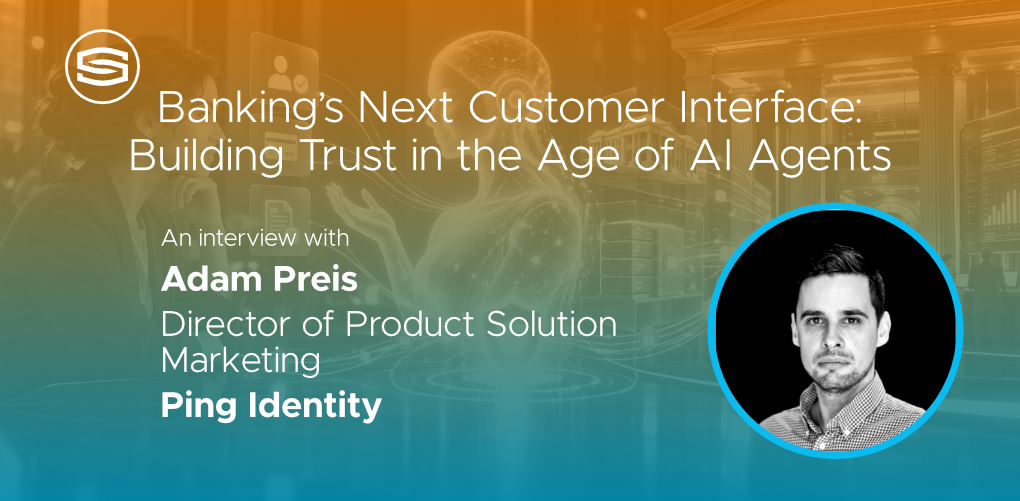
Banking’s Next Customer Interface: Building Trust in the Age of AI Agents
Mon, 12 Oct 2026

For years, banks have been trying to remove friction from digital banking. Fewer clicks, fewer authentication steps and faster journeys have become shorthand for better customer experience.
Agentic AI could turn that thinking on its head.
After seeing that Adam Preis, Director of Product Solution Marketing at Ping Identity, co-authored a white paper with Deloitte: “Trust, Risk and Reward: Building the Identity Fabric for Agentic AI in Financial Services”, I was keen to interview him to explore a future in which the customer may no longer interact directly with their bank at all. One where instead, an AI agent could research products, compare providers, prepare applications, move money or even switch financial relationships on the customer’s behalf.
That changes much more than the user interface; it changes the chain of trust that underpins banking.
As Adam put it, banks will increasingly need to establish not only who the customer is, but what kind of agent is acting, where it came from, who authorised it, what it has permission to do and whether a particular action should be allowed at that precise moment.
That is a very different model from authenticating a human who logs into a banking app.
Banking’s Chain of Trust Is Becoming More Complex
One distinction Adam made early in our discussion was between different categories of agents we can expect in the future:
- Bank agents: A bank might create its own agent and provide it to customers. In that case, the bank knows how the agent has been configured, what controls surround it and how it is supposed to behave.
- Customer agents: The situation becomes more complicated when customers create or configure their own agents. A bank may have little visibility into where that agent originated, what instructions it has received or what else it has been authorised to do.
- 3rd party agents: These are external agents created by other providers like fintechs or even an entirely new category of service provider (or the AI platforms themselves). These could become intermediaries between customers and multiple financial institutions, comparing products and services and potentially recommending that customers move elsewhere when a better option is available. This is where agentic AI stops being simply a technology question and starts becoming a strategic one.
If customers increasingly interact with banks through independent agents, the bank may lose control of the primary customer interface.
Agentic AI Could Make Banking More Competitive
That raises an intriguing question about loyalty. Imagine giving an agent permission to continuously compare mortgage rates, savings products, investment options or account fees. If it finds something better elsewhere, it could recommend a switch or perhaps eventually execute that switch on your behalf.
For customers, that could be enormously valuable, but for banks, well, not so much!
Adam suggested that this could fundamentally change the relationship between banks and customers. If agents make switching easier, institutions may have to work much harder to remain competitive rather than relying on customer inertia. This could also alter the meaning of digital engagement. Banks have spent years investing in apps, websites, personalisation engines and loyalty programmes, but if an AI intermediary becomes the customer’s preferred interface, those investments may become less important. The future banking experience could increasingly involve one agent talking to another agent, with the customer only occasionally stepping into the conversation. In that world, banks may have to optimise not only for human customers, but for machine intermediaries that are constantly comparing the quality, cost and convenience of competing services.
The Future of Customer Experience May Require More Friction, Not Less
Perhaps the most counter-intuitive part of our discussion concerned friction.
If an AI agent can act quickly and autonomously, it is tempting to assume that the goal should be to remove every possible obstacle, but Adam argued that financial services cannot work that way.
Some friction is essential because financial services operate through a chain of trust. The real question is not whether friction exists, but whether it is warranted. A £20 payment should not necessarily require the same controls as a £10,000 international transaction. Equally, refinancing a property carries very different risks from renewing motor insurance.
The interesting part is that AI could actually make that friction more intelligent.
Instead of forcing every customer through the same process, banks could introduce human approval or additional verification only when the circumstances justify it. Customers might even be able to specify how much autonomy they want to delegate. Some may prefer to approve every significant step. Others may want an agent to manage almost everything and only involve them when something unusual (by their definition, not the bank’s) happens.
That creates a very different vision of customer experience: not frictionless banking, but context-aware friction that, paradoxically, could become a source of trust. If my agent tells me it has secured a surprisingly generous loan with almost no checks whatsoever, I may have good reason to become suspicious (I’m already wary of LLM’s that have a habit of being overly optimistic). A well-designed intervention from the bank could reassure me that the system is behaving responsibly.
Trust Has to Work in Both Directions
Another important point is that banks are not the only party that needs reassurance; customers will also need confidence that an agent claiming to represent their bank is genuine.
We already see criminals impersonating banks and financial institutions and AI agents could create another surface for impersonation and fraud. As Adam pointed out, trust becomes triangular. The bank needs to trust the customer and the agent, while the customer also needs to know that the institution or agent they are interacting with is legitimate.
That means provenance becomes critical.
Banks will need mechanisms to establish where agents originated, whether they are recognised, what they are authorised to do and whether their behaviour remains within expected boundaries. At the same time, conventional human identity verification does not disappear. Voice interfaces may become more natural, but voices can also be spoofed. Knowing that a genuine human sits behind a particular instruction remains foundational.
Agent identity therefore becomes an additional layer of trust rather than a replacement for customer identity.
Liability Could Become One of Agentic Banking’s Hardest Questions
The most difficult part of the conversation came when we explored what happens when everything appears to work correctly, yet the outcome is wrong.
Imagine that a customer legitimately authorises an external AI agent. Authentication succeeds. The agent has permission to act. But it misunderstands an instruction and moves money somewhere the customer never intended.
Who is responsible?
The customer who gave the instruction? The entity that supplied the agent? The bank that executed the request? Or the organisation that failed to insert an appropriate human approval step? Adam was careful not to offer a legal judgement, but he highlighted how quickly liability becomes complicated when third-party agents become involved.
With a bank-owned agent, responsibility may be easier to determine. Once customer or 3rd party agents begin communicating directly with banking systems, the boundaries of responsibility become far less clear.
This makes auditability particularly important.
Banks may need to preserve a detailed record of which agents were involved, what they were authorised to do, what actions they took and how authority passed between participants. In other words, understanding who did what may no longer be sufficient. Banks may also need to understand which agent did what, for whom, under which authority and in what sequence.
The Bigger Challenge May Be Organisational, Not Technological
When I asked Adam what he would prioritise if he were sitting on the executive committee of a Benelux bank today, his first answer was unsurprising: understand which agents are operating within the environment, where they originated and what they are authorised to do.
His second answer was arguably more important: this can no longer be treated simply as an IT issue.
Agentic banking cuts across technology, compliance, risk, customer experience, operations and individual business lines. Adam argued that banks will need an integrated response rather than the siloed approach that has historically characterised areas such as identity and open banking.
He described the need for a new “organisational fabric”.
That phrase stayed with me.
Because the more we discussed agentic banking, the clearer it became that implementing the technology may not be the hardest part. A bank can introduce an agent relatively quickly. Changing operating models, approval processes, liability frameworks, compliance controls and organisational responsibilities is considerably harder.
Preparing for a Customer Interface Banks May Not Control
Banks are moving at very different speeds: some are pushing ahead aggressively, while others appear more willing to watch early adopters make mistakes before deciding where to invest.
Adam compared the emerging landscape with open banking, although he also stressed that agentic AI is moving faster and is significantly more complex. New providers could emerge that force incumbents to rethink their propositions, just as fintech challengers did during the earlier stages of open banking.
The crucial difference may be the customer interface.
Open banking created new ways for third parties to access financial data and initiate services. Agentic AI could create an intermediary that increasingly sits between the customer and the bank itself. If that happens, the competitive question becomes much bigger than whether a bank has deployed its own AI assistant.
Banks will need to decide:
- how they interact with agents they did not create,
- how much authority those agents should receive,
- how they prove who those agents represent and
- how they protect customers without eliminating the convenience that makes agentic banking attractive in the first place.
Perhaps the biggest mistake would be to think of this simply as another channel.
If the customer eventually delegates much of their financial life to an intelligent intermediary, agentic AI could redefine not only how customers interact with banks, but who controls that relationship.
Trust will still sit at the centre of banking.
The challenge is that banks may soon have many more parties to trust.
(If you are interested in digging even deeper into this topic, Adam recently co-authored another white paper, this time with PWC: “From Digital to Agentic Channels: The Identity Control Plane for the New Customer Interface In Financial Services, Insurance, and Retail” which you can download on the link).
The Banking Scene: Director's Cut
Adam shared far more insights than Andrew's summary (although he did his best to do the interview justice 😅), so if you prefer to hear directly from Adam, have a watch or listen below or follow along on your favourite podcast platform here (and don't forget to subscribe so that you don't miss out on more insights from industry experts!).