
Insights & Opinions
Reinventing the Art of the Possible: Insights from The Banking Scene Art Night 2025
Tue, 25 Nov 2025

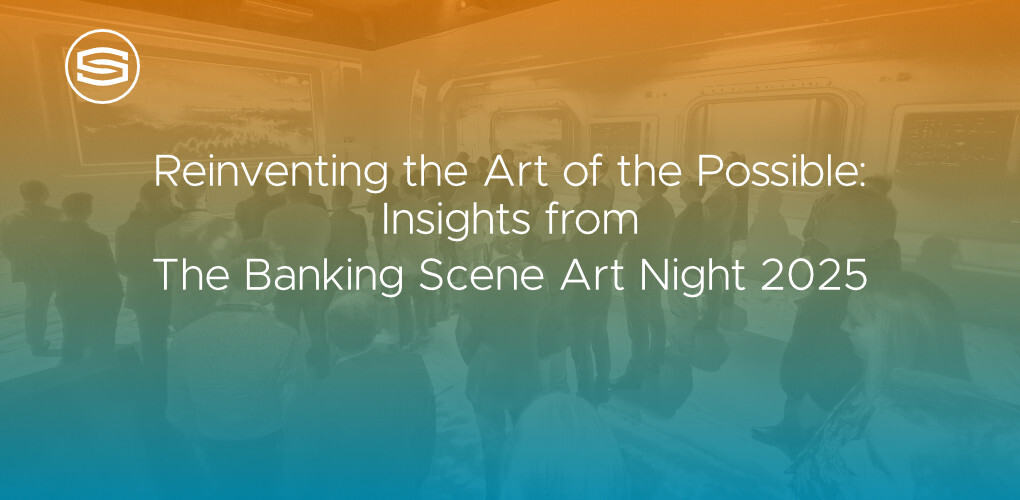
At this year’s The Banking Scene Art Night, we explored a theme that is becoming increasingly relevant for financial services: Reinventing the Art of the Possible.
I hope you are one of those who actually joined us and are seeking a reminder of the learnings, rather than just a summary, because the feedback on this event was overwhelming.
Over 2 hours, our speakers shared how they are rethinking assumptions, reimagining customer relationships, and reconsidering the role banks should play in society.
What made the evening special was the coming together of different perspectives. Whether the topic was SME automation, intent-driven digital ecosystems, AI-powered fraud defence, organisational culture, or artistic storytelling, all speakers wrestled with a similar question:
How do we redefine what is possible in a sector long defined by constraints? And how to keep doing that once a new definition of the possible set is established?
Below is a rational synthesis of the most important takeaways from the evening. Unfortunately, we cannot write down the impact the evening had on the audience, since that experience is what makes The Banking Scene Art Night so unique.
GoDutch: Making SME Finance Effortless
Thomas Vles opened with a challenge familiar to many SMEs. Thomas is the founder and CEO of the Dutch neobank GoDutch.
He found that financial admin is costly and time-consuming. GoDutch responds with a unified platform that integrates invoices, payments, payroll, reconciliation, and accounting.
What stood out was the attention to execution:
- AI handles most of the back office, while human support remains central to customer experience, because that is what these customers expect, he explained
- KYC and KYB are completed in three hours, setting a new benchmark for onboarding in The Netherlands (and beyond)
- Owning the full technology stack allows GoDutch to automate what others cannot
A striking insight came from early design of GoDutch’s business model. The company tried combining cashback with climate contributions, expecting both to appeal. Customers eagerly embraced the cashback element but showed significantly less interest in the environmental contribution.
Instead of abandoning the idea, GoDutch decided to keep the climate element as part of its core identity, not as a commercial feature but as a long-term commitment. The lesson is that purpose should be built realistically, in ways that do not rely on customer altruism, yet still reflect the company’s values.
The value of GoDutch becomes clearest when seen in real-life scenarios.
Example 1: Automated invoice processing
Many SMEs spend valuable time processing invoices scattered across different email accounts. GoDutch provides a dedicated invoice inbox that automatically captures all documents.
AI extracts supplier details, payment references, VAT, and categories, schedules payments for the due date, reconciles transactions, and forwards a single, clean, enriched record to the accounting system.
What once took minutes per invoice is reduced to seconds, improving accuracy and eliminating repetitive manual work.
Example 2: Seamless employee onboarding and offboarding
Hiring a new employee typically triggers a long list of disconnected tasks: payroll updates, salary payments, wage tax notifications, expense cards, system access and more.
With GoDutch, onboarding becomes a seamless process. Payroll is updated, salary and tax rules are established, the expense card is issued, and everything is synchronised with the accounting system.
Offboarding reverses the process automatically, cancelling subscriptions, removing access rights, and deactivating cards.
For small teams, this feels like adding a virtual colleague and significantly reduces operational risk.
KBC: The Rise of Intent-Driven Banking
Karen Van de Woestyne brought one of the most strategic perspectives of the evening. Karen was recently appointed General Manager, Transform and Ecosphere at KBC Bank. She explained that banking has traditionally been present only at life’s financial peaks, such as mortgages and car purchases. It circled around financial products and sales.
Karen argued that banks must shift towards the daily valleys of life: the routine decisions around housing, mobility, repairs, planning, and logistics.
This shift requires a focus on intent.
Surveys and demographics no longer reveal what people truly value. Customers often say one thing, think another, and ultimately behave differently. Intent, therefore, needs to be observed, not asked.
KBC’s emerging intent engine interprets behaviour, life events, content consumption, and contextual signals to anticipate customer needs.
Kate Coins add an engagement layer that reinforces journeys in a meaningful way. With over 150,000 active users, KBC is demonstrating how loyalty can grow when it is contextual and timely.
This approach moves the bank from a transactional role toward a digital companion that supports customers across the full span of daily life.
Example 1: Supporting the housing journey
A young customer browsing content about buying her first apartment receives a pre-approved budget estimate, suggestions for relevant properties, and Kate Coins. When she chooses a property, these Coins can be used for services such as home inspections, contractor support, or moving logistics. This reduces friction and helps her take the next steps with confidence.
Example 2: Strengthening the mobility journey
A customer exploring car ownership receives tailored content, financing guidance, and eventually a car loan offer. Once the loan is accepted, Kate Coins can be redeemed for tire changes, maintenance services, or even entry to the Motor Show. The relationship does not end with the loan signature but continues throughout the ownership lifecycle.
These examples show how Kate Coins reinforce the idea of KBC as a digital companion, staying present in the everyday decisions behind major purchases.
XTN Cognitive Security: Fraud in the Age of Autonomous Agents
Guido Ronchetti, CTO at XTN Cognitive Security, issued a clear warning. Artificial intelligence is changing fraud more quickly than it is changing banking.
When customers use AI agents to manage their finances, their behaviour begins to resemble automated patterns. These patterns are often the same indicators that fraud systems traditionally flag.
Meanwhile, attackers are rapidly learning how to weaponise AI. Autonomous agents can mimic users, produce deepfakes, adapt in real time, and improvise attack paths that no human could execute.
The result is a significant change. Fraud detection must transition from analysing human behaviour to examining the behaviour and intent of digital agents.
In the near future, fraud defence will be AI against AI.
Cultural Foundations for Continuous Change
In the panel discussion with Stijn Cloet (General Manager Belgium, Viva.com), Filip Rombouts (Tribe Lead Business Banking, ING Belgium), and Isabelle Waty (Group Head of Intelligence and Client Experience, Degroof Petercam), several clear conclusions emerged about what truly enables continuous change in financial institutions:
1. Simplicity unlocks speed
Organisations innovate faster when they remove unnecessary governance, keep decision-making close to customers, and trust teams to act. Excessive complexity, not regulation or competition, is often the real barrier. None of that is of course possible without the right cultural framework.
3. Culture must be embedded across the organisation
Innovation cannot sit in a single unit. It needs to live inside business lines, digital, marketing, and operations, supported by shared KPIs and a common purpose.
4. Psychological safety drives experimentation
Teams challenge assumptions and stop failing projects only when they have the mandate to do so. Fear of failure remains one of the biggest obstacles to adaptability.
5. Empowerment beats hierarchy
Small, autonomous teams that own both change and operations move significantly faster than traditional structures. Continuous change requires leaders who enable progress rather than control it.
6. The biggest threats come from within
Internal silos, conflicting incentives, and outdated processes slow organisations far more than external competition. Continuous change begins with removing internal friction and aligning teams around customer outcomes.
Artist Lisa Russell: Why Banking Needs Storytelling
Lisa Russell closed the evening by challenging us to rethink the relationship between creativity and finance.
Her work with the United Nations demonstrates how storytelling can give voice to communities that are often excluded from traditional narratives. The other way around, storytelling can carry complex ideas into communities that formal communication often struggles to reach, such as financial education.
AI, in her view, is a creative amplifier. It allows people without access to expensive tools to produce professional-quality music, visuals, and narratives. She also highlighted the financial needs of creatives and gig workers, underserved communities that remain outside traditional banking models.
Her immersive artistic piece did not address banking directly. Yet, it used symbolic storytelling to surface critical questions about the kind of future we are collectively creating, a future in which the decisions of the financial services industry play an essential role.
A New Frontier for Financial Services
Across the evening, a clear pattern emerged.
- Intent is becoming the organising principle for the next generation of financial services
- AI is reshaping customer behaviour, fraud patterns, and creative expression
- Culture is the biggest determinant of speed and innovation
- Purpose only succeeds when it aligns with real human behaviour
- Relevance requires moving beyond transactions toward context and companionship
Reinventing the Art of the Possible is more than just a theme: it is a strategic necessity for organisations that want to stay relevant in an increasingly complex and dynamic financial landscape.
The Banking Scene Art Night made one thing very clear: reinvention is already underway, and the opportunities are far larger than the constraints.
The Banking Scene: Director's Cut
In a very relaxed "behind the scenes" session, Rik and Andrew discussed their highlights from The Banking Scene Art Night and went a bit deeper into some of the points raised by the speakers, sharing their own views and a couple of nuggets not included in the article above.
You can watch below or follow on your favourite podcast platform here.
And the full session from Guido Ronchetti can be seen here: